Ready to seek assistance with your US taxes?
Filing US taxes as an American abroad is complex. We help make it easy for you.


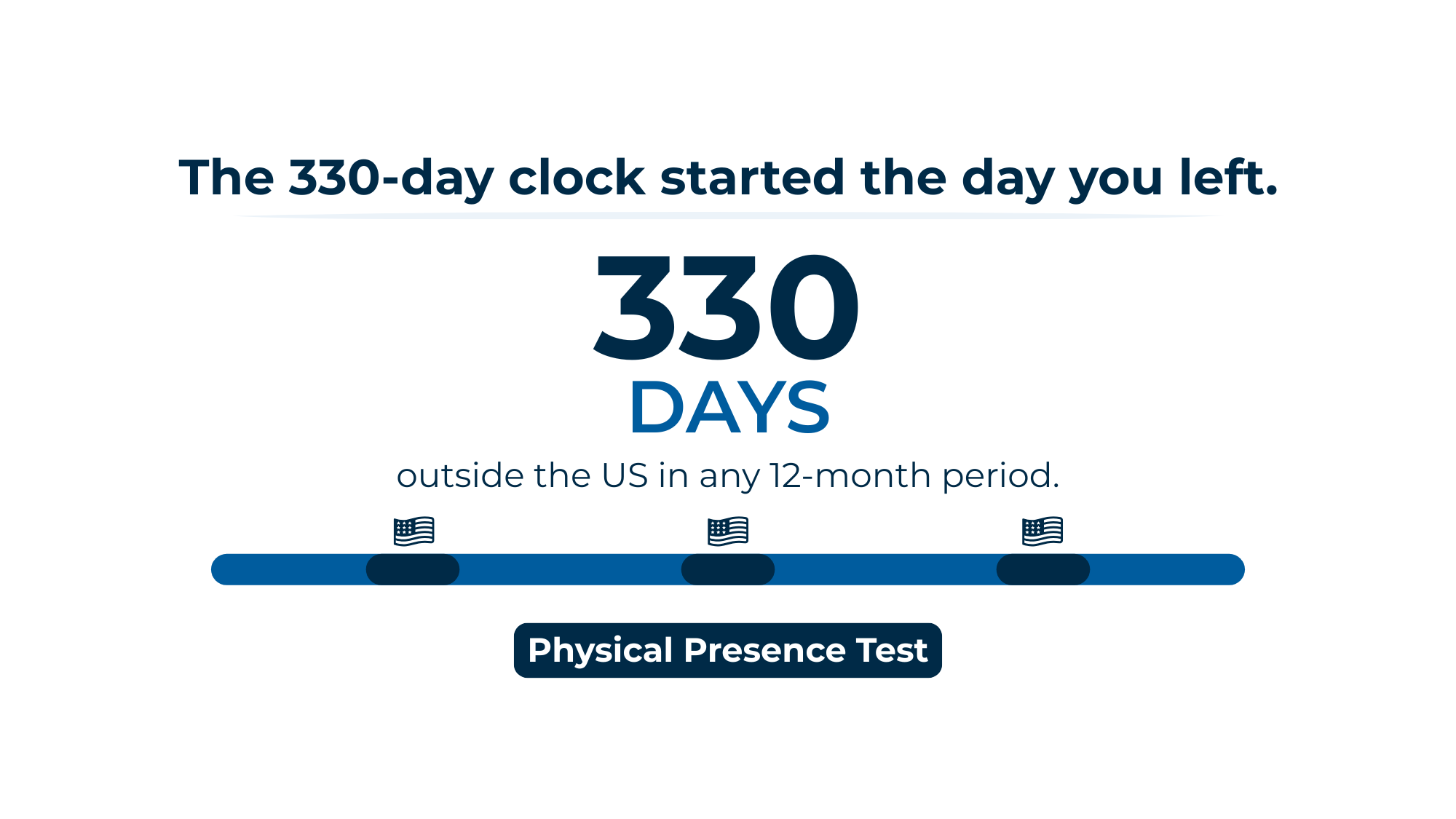

The Physical Presence Test started counting the day you left the United States.
Most people who move abroad do not realize this until they are trying to file their first expat return, at which point they have months of undocumented travel and a growing sense that they may have already made an expensive mistake.
The good news is that the Physical Presence Test is one of the most straightforward requirements in the US tax code for Americans abroad. It counts days. Either you were outside the US or you were not. But straightforward does not mean automatic. Getting from “I moved abroad this year” to “I qualify for the FEIE” requires building a specific record from day one. This article covers exactly what that record looks like and how to build it.
The Physical Presence Test requires you to be physically present in a foreign country or countries for at least 330 full days during any consecutive 12-month period. That 12-month period does not have to align with the calendar year. It can start on any date, which is one of the most useful features of the test for people who move abroad mid-year.
A full day means a complete midnight-to-midnight period spent outside the United States. The day you depart the US and the day you return to the US do not count as qualifying days, even if you spend most of those days abroad.
For someone who moved abroad in 2025, the 12-month window might run from the day after their first full day outside the US through the same date the following year. If you left the US on June 1, 2025, your first qualifying day is June 2, and a potential 12-month window runs June 2, 2025 through June 1, 2026.
If you reach 330 qualifying days within that window, you pass the test for the period it covers. The FEIE is then prorated based on how many of those qualifying days fall within each calendar tax year. Days that fall in 2025 apply to your 2025 return. Days that fall in 2026 apply to your 2026 return.
This means your first year abroad will typically produce a partial FEIE rather than the full annual exclusion, because your qualifying period spans two tax years. That is expected and normal. The important thing is that the clock is running, and the record you build now is what supports the claim when you file.
Before you can file Form 2555 and claim the FEIE, you need to choose a specific 12-month period on which your qualification is based. You are not locked into the calendar year. You can choose any 12-month window that gives you at least 330 qualifying days.
This flexibility matters most for people who had US trips planned shortly after moving abroad. If you moved in January but had a three-week trip back to the US in March, starting your qualifying window after that return trip may produce a cleaner 330-day count than starting from January.
The right way to approach this is to track every day of your first year and test multiple 12-month windows before you file. The window you choose is reported on Form 2555, line 16. Choosing the window that produces the highest qualifying day count is legal and expected.
You may also need to file for an extension if your chosen qualifying period has not yet ended by the time your return is due. Filing on extension to wait until after your qualifying period is complete is a standard approach for first-year expats and does not create any compliance issues.
What to track from day one
This is the practical core of this article. The record you need is simple, but it has to be built continuously rather than reconstructed from memory at filing time.
Every US entry and exit date. Log the specific date you leave the US and the date you return for every trip. The departure date and arrival date are not qualifying days. The days in between are. A simple spreadsheet with columns for “departure from US,” “arrival back to US,” and “qualifying days in between” is enough.
Where you were on each day. For your qualifying days to count, you need to have been in a foreign country, not in transit through international waters, not in a US territory, and not back in the US. Logging your country of location by date is good practice, particularly if you travel between multiple countries.
Documentation that corroborates your log. Your word alone is not sufficient if the IRS ever reviews your return. The supporting evidence that holds up includes passport stamps showing entry and exit dates, flight records and boarding passes, hotel receipts or Airbnb confirmations, credit card statements showing foreign transactions on specific dates, and lease agreements or rental contracts for your foreign residence.
You do not need to submit this documentation when you file. You need to have it available if the IRS ever asks. Building the record as you go is significantly easier than trying to reconstruct it from memory months or years later.
How to handle travel days. A travel day is any day when you move between the US and a foreign country. The key question is where midnight falls. If you departed the US on a Monday at 11pm and landed in a foreign country on Tuesday at 7am, Monday is not a qualifying day but Tuesday is, provided you spent the full midnight-to-midnight period of Tuesday outside the US. Logging your departure and arrival times on travel days, not just dates, is worth the extra thirty seconds it takes.
Transit through the US. If your international travel involves a connection through a US airport, that day does not count as a qualifying day even if you never cleared customs or left the terminal. Any day you are physically present in the US, for any reason, is not a qualifying day.
The simplest system that works is a shared spreadsheet with three columns: date, location, and qualifying status (yes, no, or travel day). Update it weekly rather than daily if daily feels too much. The goal is a complete record, not a perfect one built in real time.
Several apps also support day-tracking for exactly this purpose. TaxBird, Taxnomads, and similar tools are designed for expats tracking Physical Presence Test days and sync across devices. They are worth using if you travel frequently or move between multiple countries, because they automate the location logging and calculate your running day count automatically.
Whichever method you use, the habit that matters most is updating your log consistently. A log that stops in August is almost useless for a return covering the full year.
Not starting to track immediately. The most common and most avoidable mistake. Every undocumented day is a day you may not be able to count if the IRS ever requests supporting evidence.
Assuming the calendar year is the only option. First-year expats who moved abroad mid-year sometimes believe they cannot qualify for the FEIE that year because they were not outside the US for 330 days within the calendar year. The 12-month window flexibility is designed specifically for this situation. Test multiple windows before concluding you do not qualify.
Counting travel days as qualifying days. Departure and arrival days are not qualifying days. Over a full year of travel, incorrectly counting these days can inflate your count and create a compliance problem if reviewed.
Underestimating how quickly US trips add up. Thirty-six days in the US in a 12-month period means 329 qualifying days. You fail the test. There is no partial credit and no grace period. People who plan multiple trips back for holidays, family events, or work visits should model their planned travel against the 330-day requirement before booking, not after.
Not filing for an extension when needed. If your chosen qualifying period has not yet ended by your filing deadline, you need an extension to wait until the period is complete before filing. This is a standard situation, not a red flag. Filing prematurely without a complete qualifying period is the error that creates problems.
The Physical Presence Test is one of two requirements for the FEIE. The other is having a tax home in a foreign country. Both must be satisfied simultaneously.
Passing the 330-day count does not automatically satisfy the tax home requirement. If your regular place of business is still effectively in the US, your tax home may not be abroad regardless of where you physically slept. We covered the tax home requirement in detail in our guide to establishing your tax home abroad. If you have not read that article alongside this one, it is worth doing. The two requirements work together, and understanding both is what makes the FEIE claim solid.
Does the Physical Presence Test require staying in one country?
No. The 330 days can be split across multiple foreign countries. You do not need to establish residency in any specific country to pass the Physical Presence Test. Days in France, Spain, and Portugal all count equally toward the same 330-day total.
What if I go back to the US for a family emergency mid-year?
Any day spent in the US, for any reason, is not a qualifying day. An emergency trip reduces your qualifying day count by however many days you are in the US. If that reduction pushes you below 330 days in your chosen 12-month window, you may need to select a different window that avoids those days or consider whether the Bona Fide Residence Test is available to you instead.
Can I claim a partial FEIE if I only qualify for part of the year?
Yes. The FEIE is prorated based on the number of qualifying days that fall within the tax year. The formula is: maximum exclusion divided by 365, multiplied by your qualifying days in that tax year. A partial exclusion is better than no exclusion.
What happens if I lose my travel records?
The IRS can request documentation to support your Physical Presence Test claim. Passport stamps, flight records, bank and credit card statements showing foreign transactions, and accommodation receipts are all acceptable supporting evidence. If you have lost some records, focus on reconstructing what you can from these secondary sources. Going forward, the simplest protection is a running travel log updated regularly.
Should I use the Physical Presence Test or the Bona Fide Residence Test in my first year?
In most cases, the Physical Presence Test is the only option available in your first year abroad, because the Bona Fide Residence Test requires completing a full calendar year of foreign residency before it can be established. If you moved abroad in 2025, the Bona Fide Residence Test cannot be fully established for 2025. The Physical Presence Test, with its flexible 12-month window, is designed to serve first-year expats. Our full comparison of both tests covers when each one is the better long-term choice.
If you moved abroad this year and want to confirm your Physical Presence Test tracking is set up correctly, a consultation is a straightforward starting point. Book a consultation and we will confirm your qualifying period and what documentation you need to have in place.
Filing US taxes as an American abroad is complex. We help make it easy for you.