Ready to seek assistance with your US taxes?
Filing US taxes as an American abroad is complex. We help make it easy for you.


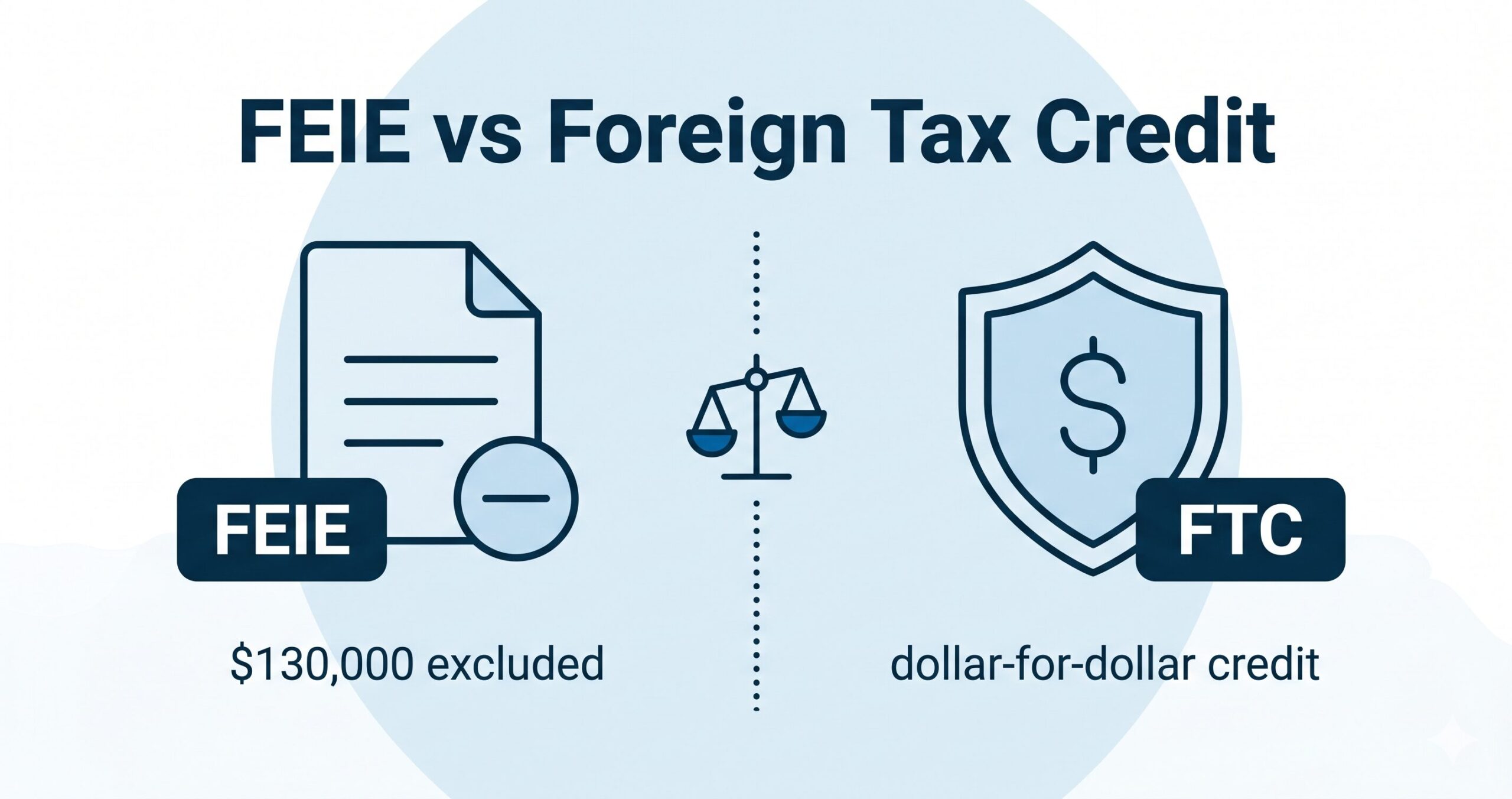

Most Americans abroad have heard of the Foreign Earned Income Exclusion. Fewer have run the numbers on whether it is actually the better choice for their situation.
The FEIE and the Foreign Tax Credit are the two primary tools the US tax code gives expats to avoid double taxation. They work differently, they apply to different types of income, and choosing between them — or combining them — is one of the most consequential tax decisions you will make as an American living abroad. Getting it wrong can cost thousands of dollars a year, compounding silently across multiple tax years before anyone notices.
This guide covers what each tool actually does, when each one wins, the traps most people fall into, and a practical framework for deciding which one applies to your situation.
The Foreign Earned Income Exclusion allows qualifying US citizens and green card holders to exclude up to $130,000 of foreign-earned income from US taxable income in the 2025 tax year. For 2026, that threshold increases to $132,900.
The key word is earned. The FEIE only applies to income you actively work for: wages, salaries, self-employment income, consulting fees. It does not apply to passive income such as rental property income, dividends, interest, or capital gains. If your income is mixed, the FEIE shelters the earned portion and leaves the passive portion exposed to US tax.
To qualify, you need to meet two requirements. First, your tax home must be in a foreign country. Second, you need to pass either the Bona Fide Residence test (established residency in a foreign country for an entire tax year) or the Physical Presence test (330 full days outside the US in any consecutive 12-month period). You claim the exclusion on Form 2555.
What the FEIE does not do is eliminate self-employment tax. If you are self-employed or running an LLC producing active income, the FEIE excludes that income from federal income tax but the 15.3% self-employment tax still applies. This is one of the most consistently misunderstood aspects of the exclusion and one of the most expensive surprises we see.
The Foreign Tax Credit takes a different approach. Rather than removing income from your US return, it keeps the income there and reduces your US tax liability dollar-for-dollar by the amount of foreign income tax you have already paid.
If you earned $120,000 abroad and paid $40,000 in foreign income tax, the FTC credits that $40,000 against your US tax bill. If the US tax on that income would have been $24,000, the FTC more than covers it. You owe zero US tax, and the $16,000 in excess credits carries forward for up to ten years to offset future US tax liability.
Unlike the FEIE, the FTC applies to both earned and passive income. Rental income taxed abroad, foreign dividends, pension income — all of it can generate credits. This makes the FTC the only tool available for reducing US tax on the passive income the FEIE cannot touch.
You claim the FTC on Form 1116. The calculation is more complex than the FEIE, particularly if you have income from multiple countries or multiple income categories, but for most expats in high-tax countries the math is straightforward.
The FEIE is typically the better choice in three situations.
You live in a low-tax or zero-tax country. If your local tax rate is lower than your effective US tax rate, the FTC does not fully cover your US liability. You pay foreign taxes, credit them against the US bill, and still owe the gap. The FEIE eliminates that gap entirely by removing the income from US taxation. For Americans living in the UAE, the Cayman Islands, or other low-tax jurisdictions, the FEIE is almost always the better primary tool.
Your income is below the exclusion threshold. If you earn $100,000 of foreign-earned income, the FEIE can exclude all of it. Zero US federal income tax on that income. If you are in a country with modest foreign taxes, the FTC credit may not be large enough to produce the same result.
You want simplicity. The FEIE is structurally simpler for straightforward employment situations. One form, one exclusion, done.
The FTC is typically the better choice in more situations than most expats realize.
You live in a high-tax country. In countries like the UK, Germany, France, Canada, or Australia, foreign income tax rates at mid-to-senior income levels often exceed the equivalent US rates. The FTC credits those taxes against your US liability and eliminates it entirely. The excess credits carry forward for up to a decade. For someone moving between countries, those banked credits can provide protection during years spent in lower-tax environments.
You have significant passive income. Rental income, dividends, pension payments, and capital gains do not qualify for the FEIE. If a meaningful portion of your income is passive, the FTC is the only mechanism available to reduce US tax on those amounts. This is particularly relevant for established expats who have accumulated foreign investments, rental properties, or pension entitlements.
You earn above the exclusion threshold. Income above $130,000 (2025) is not covered by the FEIE. The FTC can continue reducing your US liability on that excess income using the foreign taxes already paid on it.
You have children and want to preserve refundable credits. The FEIE excludes income from US taxable income entirely. That can reduce your eligibility for certain family-related tax credits that are calculated based on taxable income. The FTC keeps income on the return while reducing the tax bill, which can preserve access to those credits.
The FEIE and self-employment tax trap. The exclusion only covers federal income tax. A freelancer or LLC owner who claims the FEIE and assumes their US tax bill is zero may still owe thousands in self-employment tax on the same excluded income. For a self-employed expat earning $120,000, that can be over $18,000 in SE tax that the FEIE does nothing to reduce. The FTC does not solve this either, but understanding the exposure is essential before choosing a strategy.
The five-year revocation rule. Once you claim the FEIE and then stop claiming it — whether by switching to the FTC or by returning to the US — you generally cannot claim the FEIE again for five years without IRS approval. This is called the revocation rule and it creates a planning trap for expats who switch strategies without understanding the long-term consequences. Switching from FEIE to FTC, for example because you moved from a low-tax country to a high-tax one, triggers this rule and can lock you out of the exclusion even if your circumstances later make it the better choice again.
Defaulting to the FEIE without running the FTC calculation. The FEIE is more familiar and structurally simpler, so many expats and their domestic accountants default to it without modeling the FTC alternative. In high-tax countries, this consistently produces a worse outcome. We have reviewed returns where clients in Germany, France, and the UK were claiming the FEIE on employment income, paying zero federal income tax on that income, while leaving significant FTC carry-forward credits unclaimed that could have offset US tax on their passive income or protected them in future years.
Yes, with an important limitation. You cannot apply both the FEIE and the FTC to the same dollar of income. But you can use them on different income categories simultaneously.
A common and effective approach: use the FEIE to exclude earned income up to the $130,000 threshold, and use the FTC to reduce US tax on passive income, income above the exclusion threshold, or in future years through carry-forward credits. This layered approach is particularly useful for expats with mixed income compositions.
The mechanics of combining the two tools correctly require careful calculation. Applying both to overlapping income, or in the wrong sequence, can reduce rather than increase the benefit.
Rather than a universal recommendation, here is the set of questions that determines which approach is right for your situation.
What is your effective foreign tax rate? If it is higher than your effective US tax rate on the same income, the FTC is likely better. If it is lower, the FEIE is likely better.
What type of income do you have? Predominantly active earned income favors the FEIE. Significant passive income requires the FTC for that portion regardless of what you do with the earned income.
How much do you earn? Below $130,000 in earned income, the FEIE can cover everything. Above that, the FTC is needed for the excess.
What are your long-term plans? If you expect to move between countries with different tax rates, the FTC’s carry-forward provision and the FEIE’s revocation rule both become planning factors that affect multi-year decisions, not just the current year.
Are you self-employed? The self-employment tax exposure does not change with either tool, but it affects the overall tax picture in ways that need to be modeled explicitly.
Can I switch from the FEIE to the Foreign Tax Credit?
Yes, but with a significant caveat. If you have previously claimed the FEIE and choose to revoke it, you generally cannot claim it again for five years without IRS approval. Switching from the FEIE to the FTC triggers this rule. Before making any change, model the multi-year impact, not just the current year.
Does the Foreign Tax Credit apply to rental income?
Yes. The FTC applies to foreign taxes paid on any type of income, including rental income. The FEIE does not cover rental income at all. For expats with rental properties abroad, the FTC is the only mechanism available to reduce US tax on that income.
What happens to unused Foreign Tax Credits?
Unused FTC can be carried back one year or carried forward for up to ten years. This makes the FTC particularly valuable for expats in high-tax countries who consistently generate excess credits, as those credits can shelter US tax liability in future years when circumstances change.
Does the FEIE help with self-employment tax?
No. The FEIE excludes foreign-earned income from federal income tax only. Self-employment tax, which covers Social Security and Medicare contributions, still applies to active business income regardless of whether you claim the FEIE. This is one of the most commonly misunderstood limitations of the exclusion.
Can married couples each claim the FEIE?
Yes. If both spouses qualify independently, each can claim the exclusion up to the annual threshold. For 2025, a qualifying couple can exclude up to $260,000 combined. Both spouses must meet the tax home and either the Bona Fide Residence or Physical Presence requirements independently.
What if I earn income in multiple countries?
The FTC calculation becomes more complex with multiple source countries because the credit is calculated separately for different income categories and countries. The FEIE is simpler in that it treats qualifying earned income as a single pool regardless of country. For multi-country situations, professional review is particularly valuable.
The right choice between the FEIE and the Foreign Tax Credit depends on your specific income composition, where you live, and where you plan to be. This is one of the core decisions we work through with every expat client. Book a consultation and we will model both scenarios for your situation.
Filing US taxes as an American abroad is complex. We help make it easy for you.