Ready to seek assistance with your US taxes?
Filing US taxes as an American abroad is complex. We help make it easy for you.


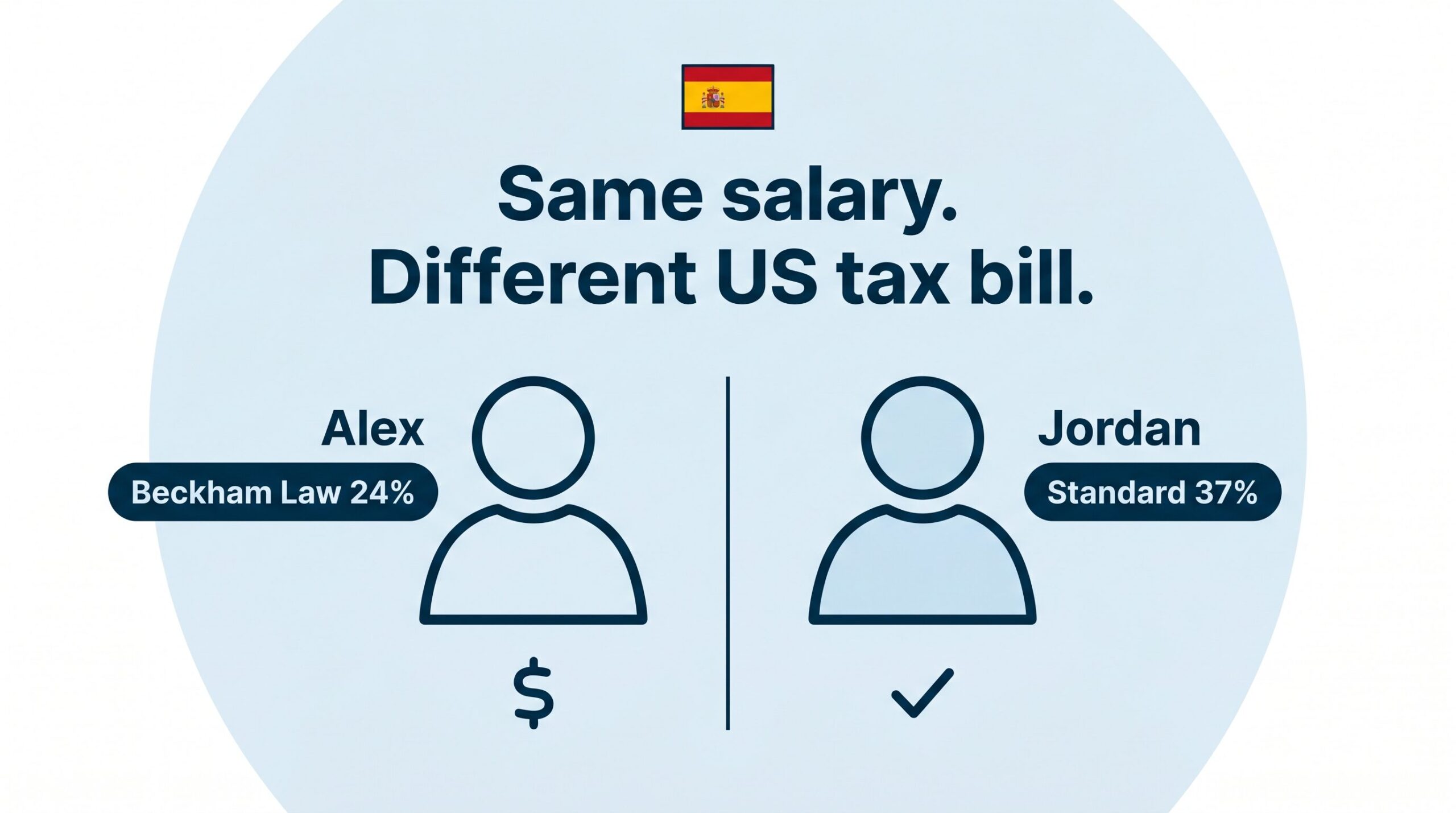

Two Americans living in Madrid. Same employer type. Same $120,000 salary. Both filing their US taxes every year.
One of them owes the IRS several thousand dollars. The other owes nothing.
The difference is not fraud. It is not a loophole. It is one decision they each made about how to structure their Spanish taxes — and whether that decision was made with the US side of the equation in mind.
This is what expat tax planning actually looks like in practice.
Before walking through the two scenarios, a quick foundation worth having.
The US taxes its citizens on worldwide income regardless of where they live. Moving to Spain does not change your US filing obligation. What it does change is which tools are available to reduce or eliminate double taxation.
The two primary tools are the Foreign Earned Income Exclusion and the Foreign Tax Credit.
The Foreign Earned Income Exclusion (FEIE) allows you to exclude up to $130,000 of foreign-earned income from US taxable income in 2025. If your salary falls below that threshold, you can potentially exclude it entirely from US tax.
The Foreign Tax Credit (FTC) takes a different approach. Rather than excluding income, it gives you a dollar-for-dollar credit against your US tax liability for income taxes you have already paid to a foreign government. If you paid $30,000 in Spanish taxes, you can credit $30,000 against what the US would otherwise charge.
Most Americans in Spain qualify for one or both. The question is which one produces the better outcome for your specific situation. And as the two scenarios below show, the answer depends heavily on how your Spanish tax situation is structured.
Spain has a special tax regime known informally as the Beckham Law, named after the English footballer who was one of its early beneficiaries when it was introduced in 2005.
The Beckham Law allows foreign professionals who move to Spain for work to be taxed as non-residents rather than residents for up to six years. The practical effect is significant: instead of being taxed on worldwide income at Spain’s progressive rates, which reach as high as 47% at the top end, you are taxed at a flat rate of 24% on Spanish-sourced income only.
For many foreign professionals moving to Spain, the Beckham Law is genuinely attractive. A flat 24% rate against progressive rates that can reach 37% or higher at a $120,000 income level is a meaningful difference.
But whether the Beckham Law is the right choice for a US citizen specifically depends on how it interacts with the US tax side of the equation. And that interaction is exactly where things get interesting.
Alex moved to Madrid two years ago, was hired by a Spanish tech company, and applied for the Beckham Law within the required six-month window. On the Spanish side, this was a sensible choice. Under the Beckham regime, Alex pays a flat 24% on $120,000 of Spanish employment income: approximately $28,800 in Spanish tax.
Now the US side.
Alex earns $120,000. The FEIE can potentially exclude the full amount since it falls below the $130,000 threshold. Under the FEIE, that income is excluded from US taxable income entirely. Zero US tax owed.
But here is the complication. If Alex uses the FEIE to exclude the income, the Foreign Tax Credit becomes irrelevant on that income because there is no US tax liability left to offset. The $28,800 in Spanish taxes paid cannot be credited against anything. The FEIE consumed the income and the FTC has nothing to work against.
Alternatively, Alex could choose the FTC instead of the FEIE. The US federal tax on $120,000 for a single filer is approximately $24,000. Alex has $28,800 in Spanish taxes to credit against that. The FTC more than covers the US liability. Zero US tax owed, with a small excess credit to carry forward.
So far, either approach gets Alex to zero US tax. Where does the problem emerge?
It emerges when Alex has income beyond the employment salary. The Beckham Law taxes Spanish-sourced employment income at 24%. Passive income, rental income, or freelance work outside Spain may face different treatment under the regime. If Alex has rental income from a US property, investment dividends, or other passive sources, the FEIE does not cover those. And the FTC credits available may not fully offset the US tax on those additional sources, particularly if the Spanish tax paid on them is lower than the US rate.
More commonly, the problem emerges when Alex chose the FEIE without running both calculations. Many expats default to the FEIE because it is simpler and more familiar. Choosing the FEIE on $120,000 of income leaves $28,800 in Spanish taxes uncredited and unused. Over several years, that adds up.
Jordan moved to Madrid at the same time as Alex, with the same salary and the same employer type. But Jordan did not apply for the Beckham Law in time. The application window was missed, and Jordan is now taxed as a standard Spanish resident.
On $120,000 of income, Jordan pays Spanish progressive income tax at an effective combined rate of approximately 37%, accounting for both national and regional rates in Madrid. That works out to roughly $44,000 in Spanish taxes.
Now the US side. The US federal tax on $120,000 for a single filer is approximately $24,000. Jordan claims the Foreign Tax Credit for the $44,000 paid to Spain.
The $44,000 credit exceeds the $24,000 US liability by $20,000.
Jordan owes zero US tax. And has $20,000 in excess FTC to carry forward and apply against US tax liability in future years.
Jordan paid approximately $15,000 more in Spanish tax than Alex. And yet when it comes to the US side, the outcome is identical at zero US tax owed. In fact, Jordan’s position may be marginally better over time because of the excess credits building up for future use.
The reason is structural. The US Foreign Tax Credit is designed to eliminate double taxation. If you pay more in foreign taxes than you would owe to the US, the credit fully covers your US liability and the excess carries forward. High foreign tax rates, which might feel like a disadvantage on the local side, actually create a buffer that protects you from US tax entirely.
The Beckham Law’s 24% flat rate, while lower than standard Spanish progressive rates, may in some scenarios be lower than the effective US tax rate on the same income. When that happens, the FTC does not fully cover the US liability, and the gap becomes US tax owed.
This is not an argument against the Beckham Law. For many Americans moving to Spain, particularly those earning above the $130,000 FEIE threshold, or those with significant income sources outside Spain that the Beckham regime exempts from Spanish taxation, the Beckham Law remains genuinely beneficial. The math works differently at different income levels and income compositions.
The point is that the Spanish tax decision and the US tax decision are not independent of each other. Optimizing one without understanding how it interacts with the other can produce results that neither decision, taken alone, would have predicted.
This scenario plays out in different forms across every country where Americans live. The specific tool changes, the underlying dynamic does not.
A Spanish accountant will optimize for Spain. A domestic US accountant will optimize for the US. Neither one is looking at the intersection of both systems, and that intersection is where the most consequential decisions get made for US citizens living abroad.
After 15 years of working with expats across dozens of countries, the situations that cost people the most are almost never the result of deliberate decisions to do something wrong. They are the result of two reasonable, well-intentioned decisions made in isolation that did not account for how they would interact.
The conversations worth having before making a decision like the Beckham Law election are the ones where someone is looking at the full picture of both systems simultaneously.
Should US citizens in Spain use the FEIE or the Foreign Tax Credit?
It depends on your specific situation, particularly your income level, whether your income exceeds the FEIE threshold of $130,000, whether you are on the Beckham Law regime, and what other income sources you have beyond your employment salary. In some situations the FEIE produces a better outcome; in others the FTC is clearly superior; in some the right approach involves elements of both. Running both calculations before choosing is worth doing with someone who understands both tax systems.
Does the Beckham Law affect US tax obligations?
Not directly. The Beckham Law is a Spanish tax regime and does not change what you owe to the US. What it does change is the amount of Spanish tax you pay, which in turn affects how much you have available to credit against your US liability through the Foreign Tax Credit. The interaction between the two is what matters.
Can US citizens in Spain use both the FEIE and the Foreign Tax Credit?
In limited circumstances, yes. You can use the FEIE on foreign-earned income and the FTC on income that the FEIE does not cover, such as passive income. However, you generally cannot use both on the same income. The strategy of layering the two tools requires careful analysis to avoid reducing rather than increasing the benefit.
What happens if I chose the wrong method in a prior year?
In most cases it is possible to amend prior returns. The rules around switching between the FEIE and the FTC are specific and there are considerations around consistency elections, but it is not necessarily irreversible. A professional review of the prior years alongside the current situation will clarify what options are available.
Does living in Spain affect my FBAR or other reporting obligations?
Yes. As a US citizen living in Spain, you are still required to file FBAR for foreign bank accounts exceeding the $10,000 aggregate threshold, and to report any other foreign financial assets that trigger Form 8938 requirements. These obligations exist independent of which method you use for the FEIE or FTC.
If you are living in Spain or planning to move there and want to understand how your Spanish tax situation interacts with your US obligations, this is exactly the kind of conversation we have every day. Book a consultation and we will look at the full picture together.
Filing US taxes as an American abroad is complex. We help make it easy for you.