Ready to seek assistance with your US taxes?
Filing US taxes as an American abroad is complex. We help make it easy for you.



The boxes are unpacked. You have a local bank account. Life abroad is starting to feel real.
And somewhere in the back of your mind, you know you need to figure out the US tax piece.
The good news is that this is more manageable than most people expect. The less good news is that a few decisions you make in the first twelve months have consequences that are difficult to reverse later. Getting the order right matters.
Here is exactly what to do, and when.
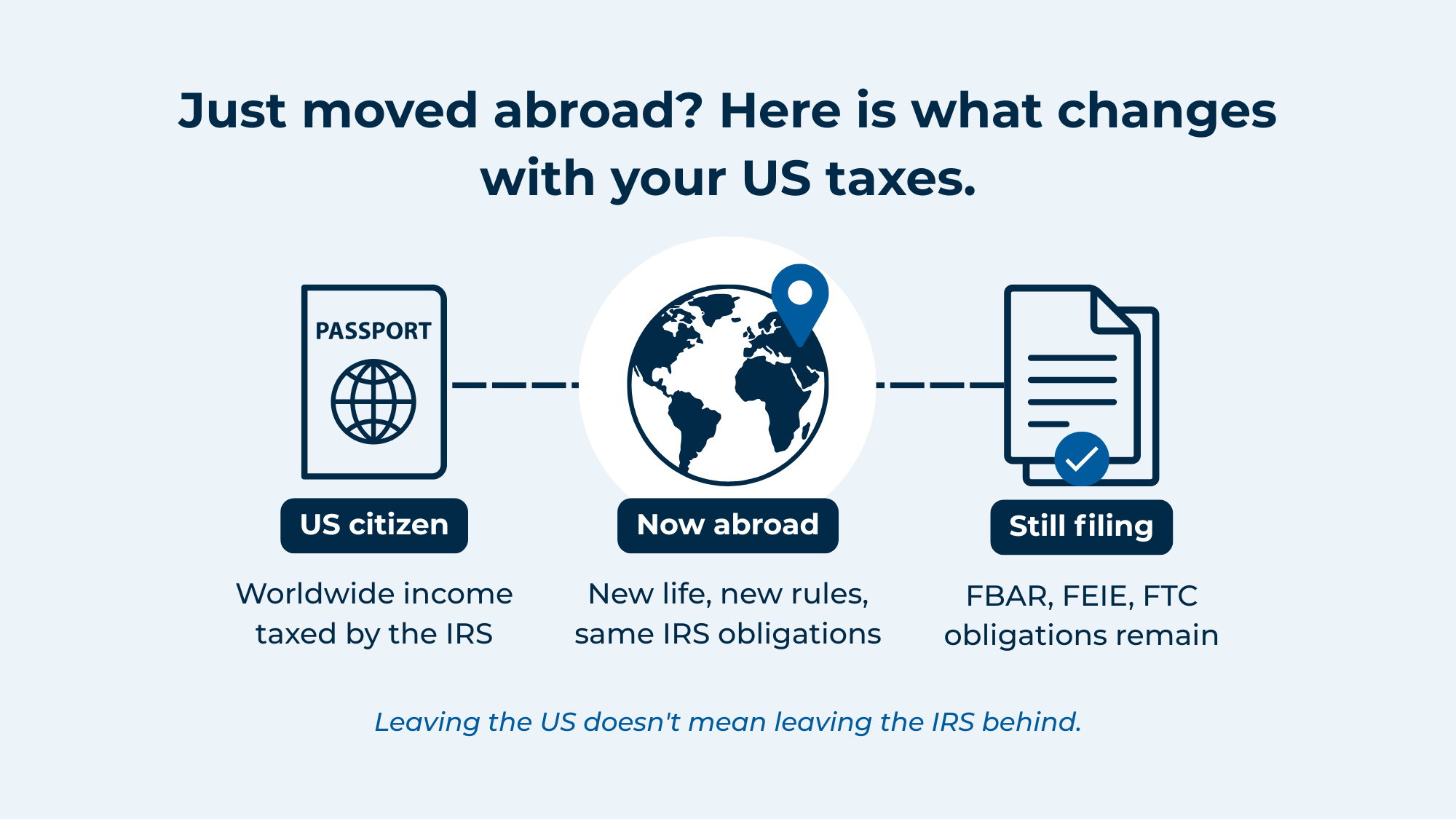
The first thing to understand is that moving abroad does not end your US tax filing requirement. The United States taxes its citizens on worldwide income regardless of where they live. If you are a US citizen or green card holder, you are required to file a US federal tax return every year your income exceeds the standard filing threshold, full stop.
This surprises people who have just paid to set up a life in another country and assumed they were done with the IRS. They are not. What changes when you move abroad is not whether you file, but how you file and which tools are available to reduce what you owe.
Your US tax deadlines changed the day you moved abroad.
As a US citizen living outside the country, you receive an automatic two-month extension to file your federal return. Your deadline moves from April 15 to June 15, with no forms required. This extension applies automatically if your tax home was outside the US on April 15.
One critical point: this extension covers filing, not payment. If you owe tax for the year, interest begins accruing from April 15 regardless of when you file. If you expect to owe anything, making an estimated payment by April 15 stops that clock.
If you need more time beyond June 15, you can request a further extension to October 15 by filing Form 4868 before the June 15 deadline.
This is the step most new movers skip because it does not feel urgent, and it becomes one of the most expensive mistakes of their first year abroad.
To qualify for the Foreign Earned Income Exclusion, which can exclude up to $130,000 of your foreign-earned income from US federal tax in 2025, you need to meet one of two tests. The Physical Presence Test requires you to be physically outside the US for at least 330 full days in any consecutive 12-month period. The Bona Fide Residence Test requires you to be a genuine resident of a foreign country for an entire calendar year.
If you are planning to use the Physical Presence Test in your first year abroad, your day count started the day you left. A day only counts if you spent the entire 24-hour period outside the US. The day you departed and the day you return to the US do not count.
A simple spreadsheet logging every US entry and exit date is enough. Border crossing records, flight receipts, and passport stamps are your supporting evidence. Start this now, not in March when you are filing.
Our full guide on the Bona Fide Residence Test vs the Physical Presence Test covers both options in detail and helps you determine which one fits your situation.
This is the most consequential tax decision you will make in your first year abroad, and it is one that benefits from running both calculations rather than defaulting to the more familiar option.
The Foreign Earned Income Exclusion excludes up to $130,000 of foreign-earned income from US taxable income. The Foreign Tax Credit gives you a dollar-for-dollar credit for income taxes paid to a foreign government.
Which one is better depends on your income level, the tax rate in your country of residence, and the type of income you have. In high-tax countries like Germany, France, or the UK, the FTC often produces a better outcome because the foreign taxes paid can fully offset the US liability with credits carrying forward for future years. In low-tax or zero-tax countries, the FEIE typically wins because there are fewer foreign taxes to credit.
There is also an important structural consideration: once you claim the FEIE and later revoke it, you generally cannot claim it again for five years without IRS approval. Getting this choice right the first time matters.
Our FEIE vs Foreign Tax Credit guide covers this decision in full with a practical framework for your specific situation.
You will almost certainly need a bank account in your new country. Most new movers open one within the first few weeks. What many do not realize is that this creates a US reporting obligation.
If the aggregate value of all your foreign financial accounts exceeds $10,000 at any point during the calendar year, you are required to file an FBAR, the Foreign Bank Account Report, on FinCEN Form 114. The threshold is aggregate across all accounts, not per account. This is filed separately from your tax return, directly with the Financial Crimes Enforcement Network, and the deadline is April 15 with an automatic extension to October 15.
The FBAR obligation exists regardless of whether you owe any US tax. It is a disclosure requirement, not a tax form. Penalties for missing it start at $10,000 per account per year for non-willful violations.
You may also need to file Form 8938 with your tax return if your foreign financial assets exceed higher thresholds. Filing FBAR does not satisfy the Form 8938 obligation; they are separate requirements.
Our FBAR guide covers everything you need to know about what to report, how, and what to do if you have missed prior years.
Federal taxes are one side of the equation. State taxes are the other, and this is the side most new movers overlook.
If you lived in a high-tax state before moving abroad, that state may still consider you a resident if you maintain connections there. California, New York, Virginia, and New Mexico are particularly aggressive about this. Driver’s licenses, voter registration, a lease in your name, or a mailing address you still use can all be used to argue that you never truly left.
The fix requires deliberate action before or shortly after the move: establishing domicile in a no-income-tax state before departing, or documenting the severance of state ties clearly. The specific steps vary by state. This is worth addressing in your first year, not your third, when the argument that you have been a resident all along is harder to make.
If you continue working for a US employer, receive stock options or RSUs, own a US LLC, have rental income from a US property, or have a foreign business interest, each of these creates additional reporting considerations that go beyond the basic expat return.
A US LLC producing active income, for example, does not automatically qualify for the FEIE in the same way employment income does. Foreign corporation ownership may trigger Form 5471. Self-employment income is subject to self-employment tax even when the FEIE is claimed, because the FEIE only covers federal income tax.
These situations are manageable, but they benefit from being addressed in the planning stage rather than discovered at filing time.
If you have just moved abroad and have not yet taken any of these steps, here is where to start.
Begin tracking your US travel dates immediately if you plan to use the Physical Presence Test. Open your FBAR obligation window in your calendar for April 15. Review your state ties and consider whether any documentation needs to be addressed. And if your situation involves a business, foreign corporation, or any income complexity, schedule a consultation before the end of the year rather than waiting for filing season.
The decisions you make in your first twelve months abroad shape your tax situation for years afterward. Most of them can be handled without drama. A few of them, if handled wrong, take years to unwind.
Do I have to file US taxes if I live abroad and earn no US income?
In most cases, yes, if your worldwide income exceeds the standard filing threshold. The source of the income does not matter. US citizens and green card holders are required to file based on worldwide income regardless of where it is earned.
When does the FBAR obligation start?
The FBAR obligation starts the first year your foreign financial accounts exceed $10,000 in aggregate value at any point during the year. If you opened a foreign account in January and it crossed $10,000 at any point before December 31, you have an FBAR obligation for that year.
Can I claim the FEIE in my first year abroad?
Yes, under the Physical Presence Test if you reach 330 days outside the US in a 12-month window that includes part of your first year. You may need to file for an extension to wait until the qualifying period is complete. Under the Bona Fide Residence Test, you generally need to complete a full calendar year before the test can be established.
What if my employer back in the US is still paying me into a US account?
Your income source and payment location do not determine whether it qualifies as foreign-earned income. What matters is whether you meet the tax home requirement and either the Physical Presence or Bona Fide Residence test. Income earned through active work while living abroad can qualify for the FEIE even if it is paid by a US employer into a US account.
Do I need to file state taxes after moving abroad?
It depends on your prior state of residence and whether you have properly severed ties there. Some states, particularly California and New York, assert continued residency based on ongoing connections. A review of your state situation is worth doing in your first year abroad.
If you have just moved abroad and want to confirm your US tax obligations are properly covered, a consultation is the right starting point. Book a consultation and we will walk through your specific situation.
Filing US taxes as an American abroad is complex. We help make it easy for you.