Ready to seek assistance with your US taxes?
Filing US taxes as an American abroad is complex. We help make it easy for you.



Before you can claim the Foreign Earned Income Exclusion, before you can use the Bona Fide Residence Test or the Physical Presence Test, before any of the tools that protect Americans abroad from double taxation become available to you, one foundational requirement has to be met.
Your tax home must be in a foreign country.
This is the requirement most expats have never heard of, and the one that quietly disqualifies people who would otherwise qualify for the FEIE. Understanding what the IRS means by “tax home”, and how it differs from where you live, where you are domiciled, and where you pay local taxes, is one of the most practically important things a new expat can get right early.
The IRS defines your tax home as your regular or principal place of business, employment, or post of duty. It is where you work, not where you live.
This distinction matters more than most people realize. You can be living in Lisbon, spending your weekends exploring the Alentejo, and building a genuine life in Portugal and still not have your tax home in Portugal if your principal place of work is effectively in the United States.
The most common scenario where this trips people up: a remote worker who moved to another country but still works exclusively for a US employer on US projects, with a US office technically still available to them. The IRS may view that person’s tax home as the US regardless of where they physically sleep.
Your tax home is not determined by where your family lives, where you own property, where you pay rent, or where you are officially registered as a resident. It is determined by where your business activity is primarily based and where you perform your work.
The FEIE has three requirements. You must have foreign-earned income. You must meet either the Bona Fide Residence Test or the Physical Presence Test. And your tax home must be in a foreign country.
All three must be satisfied simultaneously. Meeting two out of three does not work.
This means someone who passes the Physical Presence Test by spending 330 days abroad but whose regular place of work is still tied to the US may be unable to claim the FEIE. The day count is correct. The tax home is not.
The IRS is explicit about this in Publication 54: a person whose abode is in the US cannot have a tax home in a foreign country. Abode in this context means your family, economic, and personal ties. But abode and tax home are related. If your abode remains in the US, your tax home does too.
The practical steps depend on your employment situation. Each category has different considerations.
If you are an employee of a foreign employer
This is the most straightforward situation. Working for a foreign company in a foreign country, being paid by that company, and reporting to an office or operation based abroad is strong evidence that your tax home is in that country. The employment relationship itself anchors your principal place of business.
If you are an employee of a US employer working remotely
This is where most complications arise. The IRS looks at several factors: whether your US employer maintains an office you could return to, whether your assignment abroad is indefinite rather than temporary, and whether your employment duties are genuinely performed abroad rather than substantially directed from the US.
An assignment with no fixed end date, no US office maintained for your use, and duties entirely performed in the foreign country builds a strong case for a foreign tax home. A temporary assignment with a defined return date points toward a US tax home even if you are physically abroad.
If you are self-employed
Your tax home is where you conduct your principal business activity. If your clients are abroad, your work is performed abroad, and you have a genuine business presence in the foreign country, the tax home analysis points abroad. If your client base is predominantly US-based and you simply happen to be working from a different location, the analysis is more complicated.
The key documentation is consistent: foreign bank accounts used for business, foreign business registrations or contracts, foreign clients, and the absence of a US office or workspace maintained for your use.
Indefinite vs. temporary assignments
The IRS draws a firm line between indefinite and temporary. A job or assignment that is realistically expected to last more than one year, or that has no defined end date, is indefinite. An indefinite assignment abroad generally means your tax home is abroad. An assignment expected to last less than one year is temporary, and a temporary assignment generally means your tax home stays in the US.
This matters particularly for people who plan to be abroad for “a year or two and see how it goes.” That framing, in IRS terms, may actually be permanent enough to qualify. What the IRS is looking for is that you did not intend to return to the US at a predetermined date.
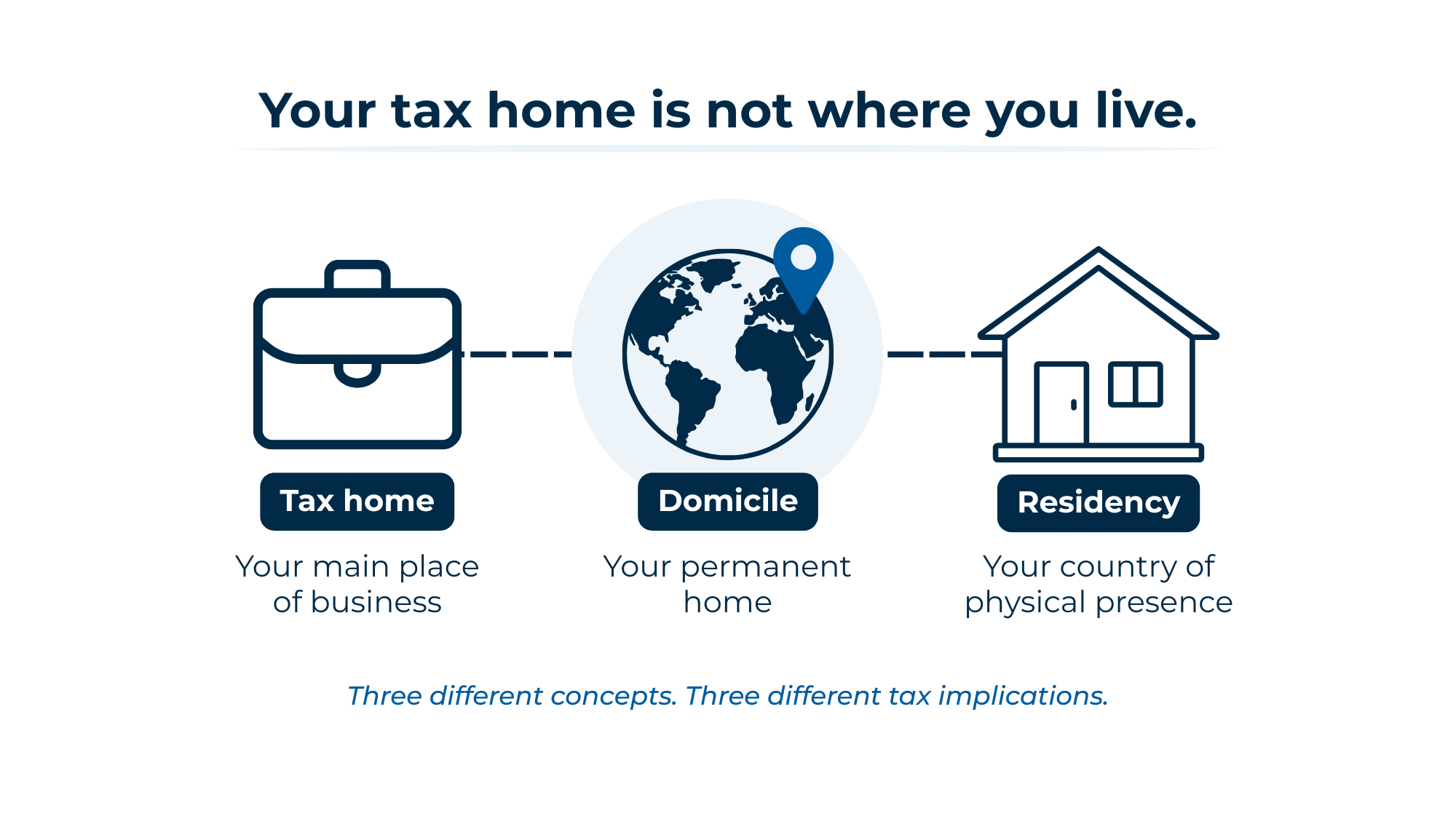
These three concepts are distinct and are frequently conflated in expat communities and even in content from firms that do not specialize in international tax.
Tax home is your principal place of business. It is an IRS concept used primarily to determine FEIE eligibility and deductibility of travel expenses.
Domicile is your permanent legal home, the place you intend to return to and consider your true home. This is primarily relevant for state tax purposes. You can have a foreign tax home for IRS purposes while maintaining a US domicile for state purposes, which is why some people continue to owe state taxes even after moving abroad.
Residency is a broader concept that varies by country and context. For US federal tax purposes, residency is determined differently from domicile. For foreign country purposes, residency is typically determined by the days you spend in that country or whether you hold a long-term visa or permit.
Understanding all three, and how they interact, is essential for anyone making a deliberate decision about their international tax situation. Optimizing only one without understanding the others is one of the more common sources of unexpected tax bills we see.
Keeping a US office or workspace available. If your employer maintains a desk, office, or workspace for you in the US, the IRS may view your tax home as remaining there even if you rarely or never use it. Getting clarity on whether this space has formally been released is worth doing.
Temporary framing of an indefinite move. Telling your employer, your friends, or yourself that you are “trying this out for a year” creates documentation of temporary intent that the IRS can use against a foreign tax home claim if reviewed.
Maintaining too many US ties alongside insufficient foreign ones. A US driver’s license, US voter registration, US banking as your primary accounts, and no foreign lease or local bank account combine to tell a story of someone whose economic center of gravity is still in the US.
Not understanding that the tax home requirement applies throughout the qualifying period. Your tax home must be in a foreign country for the entire period you are trying to qualify for the FEIE. A mid-year relocation back to the US, even temporarily, can break the tax home requirement for that period.
If the IRS ever questions your tax home, the evidence you want to have is consistent and specific. A foreign lease in your name. A foreign bank account used as your primary account. Foreign utility bills. A local phone number and address. Contracts or employment agreements with foreign entities. Evidence that your work is performed in the foreign country.
None of this needs to be elaborate. What it needs to be is consistent: every piece pointing toward the same conclusion that your regular place of business and your regular life are abroad, not in the US.
Can I have a tax home abroad if I work for a US company?
Yes, but it requires more analysis than working for a foreign employer. The key factors are whether your assignment is indefinite rather than temporary, whether your duties are genuinely performed abroad, and whether your US employer maintains a workspace for your use. A remote worker on an indefinite arrangement with no US office available can generally establish a foreign tax home.
What if my tax home is in the US but I pass the Physical Presence Test?
You cannot claim the FEIE. All three requirements must be satisfied simultaneously: foreign earned income, a qualifying test, and a foreign tax home. Passing the day count without the foreign tax home does not qualify you for the exclusion.
Does establishing a foreign tax home affect my state taxes?
Not directly. Tax home is a federal IRS concept. State taxes are determined by domicile and residency, which are separate analyses. You can have a foreign tax home while still being considered a resident of your former state if you have not properly severed those ties.
How long do I need to be abroad before my tax home shifts?
There is no specific time threshold. The IRS looks at whether the arrangement is indefinite rather than temporary. A move that is realistically expected to be permanent or open-ended establishes a foreign tax home more readily than a fixed-term assignment, regardless of duration.
Can a digital nomad who moves between countries establish a foreign tax home?
Yes, though it requires more careful analysis. The Physical Presence Test does not require staying in one country. For the tax home, the analysis focuses on where your principal business activity is based. A digital nomad with no fixed country of operation may benefit from establishing a base of operations in one country, even if travel is frequent.
Establishing your tax home correctly is the foundation of everything else in your expat tax situation. If you are not certain your tax home is properly established, a consultation is the right starting point. Book a consultation and we will work through your specific situation.
Filing US taxes as an American abroad is complex. We help make it easy for you.