Ready to seek assistance with your US taxes?
Filing US taxes as an American abroad is complex. We help make it easy for you.



For years, a certain category of international tax planning was built around one premise: some countries tax income at zero, and if you structure your life correctly, you can live in one.
That premise is not gone. But it is getting smaller every year.
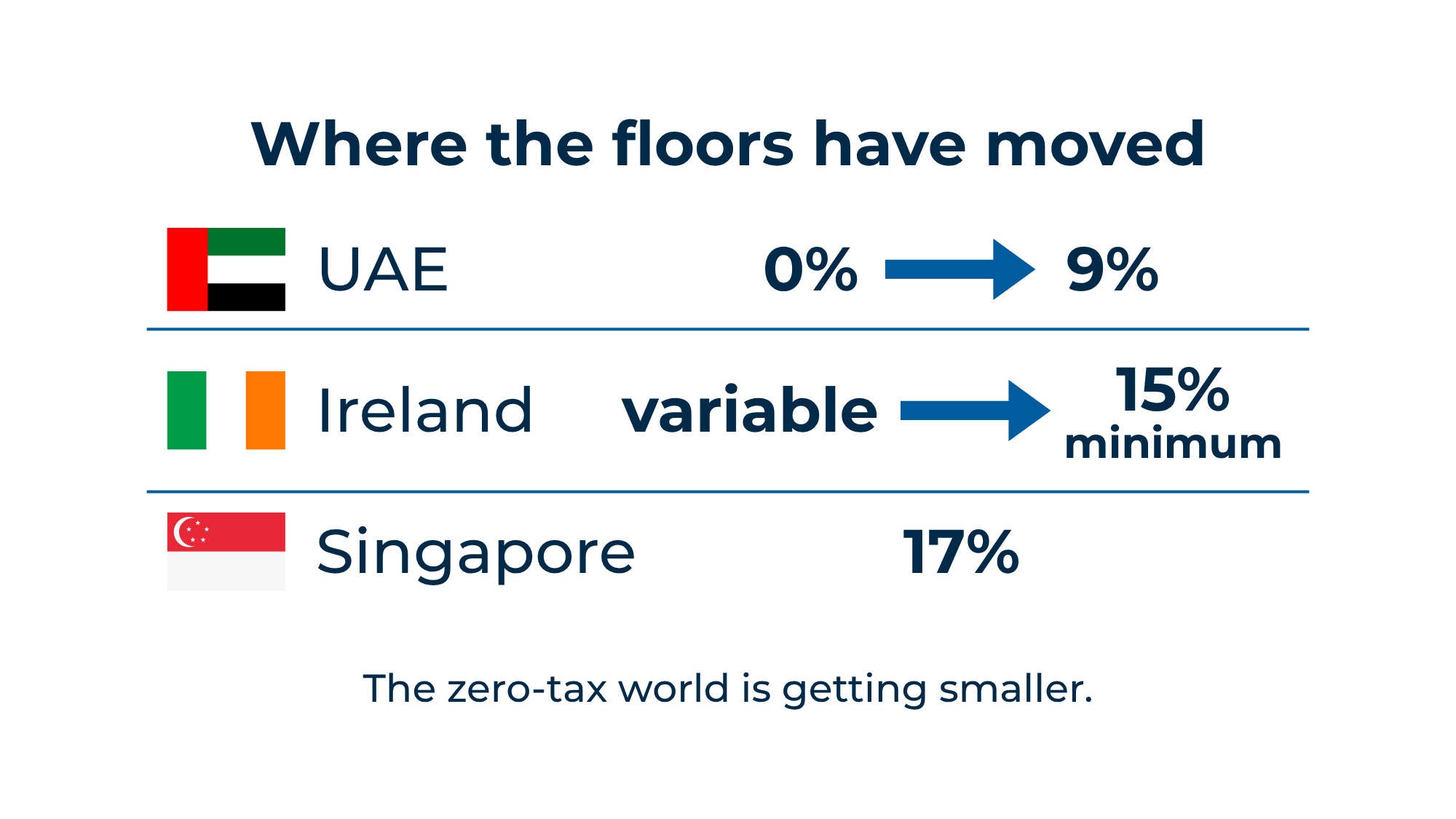
The OECD’s global minimum tax framework, known as Pillar Two, has been in force across a growing list of countries since 2024. Its goal is to establish a 15% floor on the effective corporate tax rate for large multinational enterprises, regardless of where their income is booked. Dubai moved from zero corporate tax to 9% in 2023. Singapore is at 17%. Hong Kong introduced a minimum top-up tax. Ireland, long a low-tax holdout, is implementing the 15% floor for large multinationals.
For individual American expats who are not running large multinationals, the direct legal impact is limited. But the planning environment is shifting in ways that affect anyone thinking about where to live, how to structure a business, and whether strategies that worked five years ago still work today.
This article covers what the global minimum tax actually is, what the January 2026 Side-by-Side agreement means for US citizens specifically, how zero-tax and low-tax jurisdictions are evolving, and what this means for expat planning decisions you are making right now.
The OECD Pillar Two framework establishes a 15% global minimum effective tax rate for multinational enterprise groups with annual revenues above €750 million. If a large company books profits in a jurisdiction where the effective tax rate is below 15%, other countries where the group operates can collect a top-up tax to bring the effective rate to 15%.
The mechanism has several layers. The Income Inclusion Rule allows the parent company’s country to tax low-taxed income earned by its subsidiaries abroad. The Undertaxed Profits Rule allows other countries to collect a top-up if the parent’s country does not. Qualified Domestic Minimum Top-up Taxes allow individual countries to collect the top-up themselves before another country can claim it.
For most individual American expats, this regime does not apply directly. The €750 million revenue threshold means it targets large corporations, not freelancers, small business owners, or even most mid-sized international entrepreneurs.
But the indirect effects are real and significant.
On January 5, 2026, the OECD announced a major development: US-headquartered multinational groups are now formally exempt from key portions of Pillar Two through a Side-by-Side safe harbor arrangement. The agreement recognizes that the US has its own existing framework, including NCTI (formerly GILTI) and other CFC rules, that achieves similar policy objectives to Pillar Two without the group being subject to the GloBE rules directly.
For Americans with US-parented holding structures, this matters. It means that the foreign subsidiaries of US-headquartered groups are generally protected from having Pillar Two top-up taxes imposed by other countries under the IIR and UTPR mechanisms, provided the US regime continues to qualify.
What this does not mean: the exemption applies to large US-headquartered multinationals. It does not mean that individual Americans living abroad are exempt from local tax increases driven by Pillar Two implementation. If you live in a country that has adopted a Qualified Domestic Minimum Top-up Tax, that country’s increased effective tax rates apply to you as a local resident regardless of where you were born.
This is where the global minimum tax has its most practical effect on everyday expat planning.
The appeal of certain jurisdictions for international tax planning has historically rested on low or zero local tax rates: Dubai, the UAE more broadly, the Cayman Islands, Panama, and similar destinations. The OECD framework has not directly eliminated these advantages for individuals, but it has triggered a broader upward pressure on effective tax rates in many of the most popular planning jurisdictions.
The UAE introduced a 9% federal corporate tax in 2023, effective for financial years starting June 1, 2023 or later. This does not apply to individuals’ personal income from employment or investment, but it applies to business profits of UAE entities. A US entrepreneur who previously ran a UAE company paying zero corporate tax now pays 9% at the entity level in the UAE.
Singapore, long attractive for its 17% corporate rate and various incentive schemes, implemented additional compliance requirements under its Pillar Two legislation for large groups. For smaller businesses, Singapore’s existing rate structures remain in place but the directional trend toward higher floors is clear.
Portugal’s IFICI regime, which replaced NHR, and similar incoming resident programs in Greece, Italy, and Spain continue to offer favorable rates to qualifying individuals. These are personal income tax regimes for residents, which are structured differently from the corporate minimum tax and are not directly targeted by Pillar Two. However, the broader political pressure that produced Pillar Two is also producing increased scrutiny of individual resident tax programs in some jurisdictions.
The honest summary: the floors are rising. Not uniformly, not for all taxpayers in all situations, but the trajectory is clear. Planning strategies that assumed a stable zero-tax environment are worth revisiting.
For individual US expats, the global minimum tax affects planning through three channels.
The business structure channel. If you own a foreign company and run your business through it, the local corporate tax environment in your country of residence is changing. UAE entities at 9% rather than zero changes the math on distributions, retained earnings, and the NCTI calculation on your US return. Singapore entities at 17% have always been above the NCTI high tax exclusion threshold, so NCTI exposure there is limited. Countries implementing Qualified Domestic Minimum Top-up Taxes to bring their effective rates to 15% may now also meet the NCTI high tax exclusion threshold, which could reduce your US-side exposure simultaneously.
The residency choice channel. The decision about where to establish tax residency has always been about more than local rates. Healthcare, lifestyle, visa stability, and access to financial services all factor in. The global minimum tax adds a new consideration: how stable is the low-tax advantage in your chosen jurisdiction over a five-year or ten-year horizon? Jurisdictions with deep treaty networks, strong institutional frameworks, and explicitly designed resident tax programs are likely more durable planning environments than those relying solely on low or zero rates that are now under external pressure.
The renunciation calculus channel. As covered in our video on renunciation, one of the strongest arguments against renouncing US citizenship is that the zero-tax destination advantage is eroding. If the jurisdiction you planned to live in tax-free is now at 9%, and you paid an Exit Tax to get there, the math looks different than it did five years ago. The FEIE, the Foreign Tax Credit, and the right business structure can often produce an effective rate close to or below what a zero-tax jurisdiction now actually delivers, without the permanence and cost of renunciation.
Some of the most important tools available to American expats are entirely unaffected by the global minimum tax.
The Foreign Earned Income Exclusion is a US domestic provision. It excludes foreign-earned income from US taxable income and is not subject to Pillar Two in any form.
The Foreign Tax Credit continues to work exactly as before. If the country where you live has increased its effective rates to comply with Pillar Two, that means more foreign taxes paid and more credits available to offset your US liability.
The US-Germany, US-UK, US-France, and similar bilateral tax treaties are unaffected by Pillar Two. Treaty benefits for pension income, business profits, and reduced withholding rates continue to apply.
For individual expats who are not running large multinational groups, the direct legal impact of Pillar Two remains limited. What changes is the planning environment: the assumptions you make about the stability of low-tax jurisdictions, the corporate tax costs of running a foreign entity, and the long-term trajectory of global tax rates.
If you are a US expat currently living in a low-tax or zero-tax jurisdiction, the questions worth asking are these.
Is your business structure tax-efficient under current local rates, not just historical ones? UAE corporate tax at 9%, for example, is still low by global standards, but it is not zero. The analysis of distributions, retained earnings, and NCTI exposure needs to reflect the current rate, not the pre-2023 one.
Is your residency jurisdiction likely to remain stable? Jurisdictions with formally legislated resident tax programs, strong treaty networks, and clear legal frameworks for foreign residents are more predictable planning environments than those where the favorable treatment rests on informal practice or political discretion.
Is the strategy you built three to five years ago still the best one for your situation today? The global tax floor is not the only thing that has changed. GILTI became NCTI. Portugal closed the original NHR. Spain’s Beckham Law introduced US-side complications. Germany’s solidarity surcharge changed. A review of your full structure in light of the current environment is worth doing, not because everything has collapsed, but because the details matter and they have moved.
Does the global minimum tax apply to individual American expats?
Not directly. The Pillar Two framework applies to multinational enterprise groups with annual revenues above €750 million. Individual expats, freelancers, and most small business owners are outside this threshold. The practical impact is indirect: countries implementing Pillar Two are raising effective corporate tax rates, changing the local tax environment for foreign-owned businesses, and creating directional pressure on the low-tax jurisdiction strategies many expats have relied on.
Does the January 2026 OECD Side-by-Side agreement protect US expats from Pillar Two?
It protects US-headquartered multinational groups from having Pillar Two top-up taxes imposed by other countries under specific mechanisms. For individual Americans living abroad, it does not exempt them from local tax increases that their country of residence has introduced as part of its own Pillar Two implementation.
Does Pillar Two affect the FEIE or Foreign Tax Credit?
No. Both are US domestic provisions that operate independently of the OECD framework. The FEIE excludes foreign-earned income from US taxable income. The Foreign Tax Credit offsets US liability with foreign taxes paid. Neither is subject to Pillar Two rules in any form.
How does the UAE corporate tax affect US expats running businesses there?
UAE entities now pay 9% corporate tax on business profits above AED 375,000. This applies to the entity, not to the individual’s personal income from employment or personal investment returns. For a US citizen with a UAE company, the 9% tax paid by the entity may be creditable against NCTI liability on the US return, depending on the ownership structure and whether the NCTI high tax exclusion applies.
Is zero-tax residency planning still viable for Americans abroad?
In some jurisdictions and for some income types, yes. Personal income from employment and investment is taxed differently from corporate income, and many zero or low-tax jurisdictions retain favorable treatment for individuals. What has changed is the stability of the planning environment and the effective rate at the corporate level in several historically zero-tax destinations. Strategies built on zero corporate tax in jurisdictions that have now moved to 9% need to be updated, not necessarily abandoned.
If you are reviewing your international structure in light of the global minimum tax changes, this is a planning conversation worth having now rather than at filing time. Book a consultation and we will model your specific situation against the current landscape.
Filing US taxes as an American abroad is complex. We help make it easy for you.