Ready to seek assistance with your US taxes?
Filing US taxes as an American abroad is complex. We help make it easy for you.


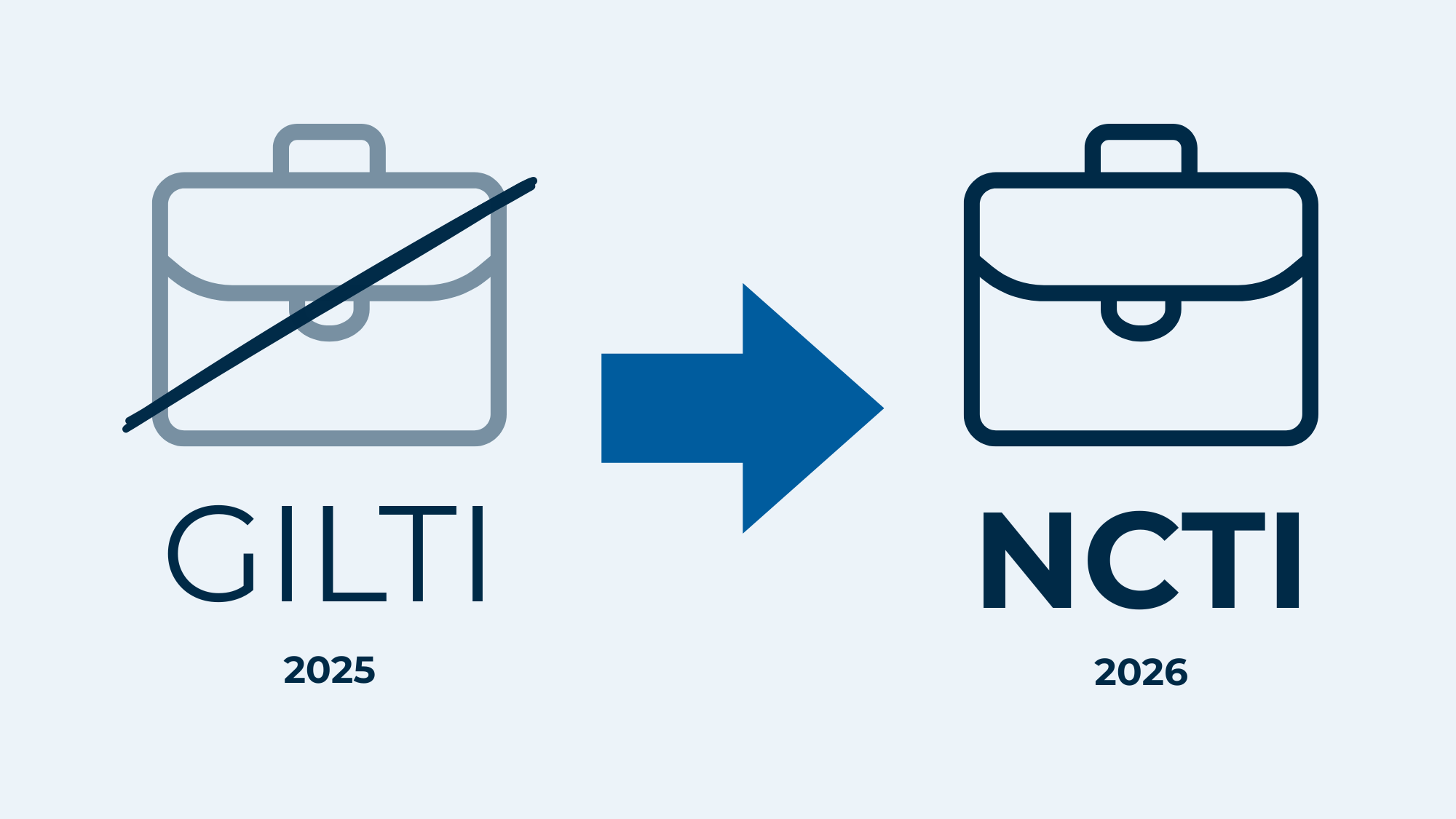

If you own a foreign corporation as a US citizen, something significant changed on January 1, 2026, and it affected your 2026 tax year from the first day of January.
The Global Intangible Low-Taxed Income regime, GILTI, which has applied to US shareholders of controlled foreign corporations since 2018, was replaced by a new framework called Net CFC Tested Income, or NCTI, under the One Big Beautiful Bill Act signed in July 2025. The change is effective for tax years beginning after December 31, 2025.
This article covers what changed, what stayed the same, who is most affected, and what to do before December 31, 2026.
One important clarification before diving in: if you are currently filing your 2025 tax return, the prior GILTI rules still apply. NCTI governs the 2026 tax year and forward.
Before covering what changed, a brief foundation on what the old regime was trying to do.
GILTI was introduced in the 2017 Tax Cuts and Jobs Act as a mechanism to prevent US multinationals from shifting profits to low-tax foreign jurisdictions. The basic logic: if you own a foreign corporation and that corporation earns income, the US wants a share of it, even if you have not distributed any profits to yourself.
Under GILTI, the taxable amount was calculated as the CFC’s net tested income minus a 10% return on the CFC’s tangible assets, known as the Qualified Business Asset Investment or QBAI. This meant companies with significant physical assets, equipment, facilities, inventory, could reduce their GILTI exposure by having more tangible assets on the books.
For most American expats running service businesses through foreign companies, QBAI was largely irrelevant because service businesses have minimal tangible assets. But for those with capital-intensive operations, it provided meaningful relief.
Under the One Big Beautiful Bill Act, GILTI has been replaced with Net CFC Tested Income. The name change comes with meaningful structural differences, some of which make the regime simpler and some of which make it harsher for certain taxpayers.
The QBAI exclusion is eliminated. Starting in 2026, the Qualified Business Asset Investment deduction no longer exists. Under the old GILTI rules, companies could reduce their taxable inclusion by a 10% return on tangible assets held by the CFC. That offset is gone entirely. All net tested income from a CFC is now potentially subject to NCTI, regardless of how many tangible assets the business holds. A foreign corporation that previously sheltered a meaningful portion of its income through the QBAI calculation no longer has that option.
The effective rate is now 12.6%. The Section 250 deduction for NCTI was set at 40% starting for tax years beginning after December 31, 2025, and is now permanent. Under the prior TCJA rules, the deduction had been 50%, producing a 10.5% effective rate. The 40% deduction produces an effective corporate rate of 12.6% on NCTI for US corporations that own a CFC. For individual shareholders who do not use a US holding company structure, the rate can be significantly higher.
The foreign tax credit haircut improved. US shareholders can now claim a foreign tax credit for 90% of the foreign income taxes paid or accrued by the CFC attributable to NCTI. Under the prior GILTI regime, the haircut limited the FTC to 80% of foreign taxes. The improvement to 90% offers greater relief from double taxation for expats whose foreign corporations operate in countries with meaningful local corporate tax rates.
The high tax exclusion threshold changed. Under GILTI, the high tax exclusion required a foreign effective tax rate of at least 18.9% for the 2025 tax year. Under NCTI, that threshold drops to approximately 14% for 2026. This is a meaningful change: more expat business owners in moderate-tax countries now qualify for the exclusion than did under the prior regime.
The NCTI change has a different impact depending on how your foreign business is structured and where it operates.
Capital-intensive businesses: The elimination of QBAI hits hardest for foreign corporations with significant tangible assets. A manufacturing operation, a business with substantial equipment or real estate, or any company that previously benefited from the QBAI offset will face a higher NCTI inclusion than under the old rules. The income that was previously excluded because of the tangible asset return is now fully included.
Service businesses in low-to-moderate tax countries: Service businesses, consulting firms, marketing agencies, software companies, and similar businesses had little QBAI benefit under the old rules because service businesses have minimal tangible assets. For these businesses the NCTI change is less dramatic in terms of the inclusion calculation. However, the effective rate change and the revised high tax exclusion threshold mean the overall tax position still needs to be recalculated for 2026.
Individual shareholders without a US holding company: For individuals who own a CFC directly, NCTI adds to taxable income. Without the Section 250 deduction available through a US C-Corp structure, individual shareholders face normal income tax rates up to 37%, unless they choose strategic elections such as the Section 962 election. The 12.6% effective rate applies to US corporations owning a CFC, not to individuals owning a CFC directly.
Expats in high-tax countries: Most European countries and Canada have corporate tax rates that exceed the new 14% high tax exclusion threshold, meaning expats in the UK, Germany, France, Japan, and Australia may be able to eliminate NCTI entirely through the high tax exclusion election. If your foreign corporation pays local tax at a rate above approximately 14% in 2026, the exclusion is worth analyzing.
Not everything changed. The fundamental structure of the regime remains intact.
NCTI still applies when you own at least 10% of a controlled foreign corporation. A CFC is still defined as a foreign company where US shareholders collectively own more than 50% of the voting power or value. You are still required to include your share of the CFC’s tested income on your US return annually, regardless of whether you distributed any profits. Form 8992 is still the form used to calculate and report the inclusion. The Section 962 election, which allows individual shareholders to elect to be taxed as a corporation and potentially access the Section 250 deduction, is still available and may be worth analyzing for your situation.
For expats with foreign corporations, the most important actions for the 2026 tax year are planning actions, not filing actions. NCTI is calculated on the 2026 income that is accumulating now.
Confirm whether the high tax exclusion applies to your situation. If your foreign corporation pays local corporate tax at a rate above approximately 14%, you may be able to make the high tax exclusion election and eliminate NCTI entirely on your 2026 return. This election has specific requirements and the analysis is worth doing with a specialist before year end.
Review your ownership structure. If you own your foreign corporation directly as an individual, the NCTI math is significantly less favorable than if it is owned through a US holding company that can access the Section 250 deduction and the 12.6% effective rate. If restructuring makes sense for your situation, the earlier in the year it is addressed the better.
Model your 2026 NCTI exposure now. Unlike the FEIE, which is calculated at filing time, NCTI accumulates throughout the year based on your CFC’s profits. Running a projection of your 2026 exposure before December 31 allows you to make planning decisions while they can still affect the outcome.
Check whether the Subpart F rules affect any distributions. NCTI is not the only regime that can tax CFC income. Subpart F income, which covers passive income and certain related-party transactions, continues to apply alongside NCTI. A full picture of your 2026 exposure requires reviewing both.
This point is worth restating clearly because it creates confusion. If you are currently completing or reviewing your 2025 tax return, the prior GILTI rules apply to that return. The 50% Section 250 deduction, the QBAI offset, and the 2025 high tax exclusion threshold of 18.9% all govern the 2025 filing. NCTI begins with tax years starting after December 31, 2025. It is a 2026 problem, not a 2025 one.
Does NCTI apply to all foreign corporations owned by US citizens?
NCTI applies when you own 10% or more of a controlled foreign corporation, defined as a foreign company where US shareholders collectively own more than 50% of the voting power or value. Foreign corporations that do not meet the CFC definition are not subject to NCTI, though other rules may apply.
What is the effective NCTI rate for individual shareholders in 2026?
Individual shareholders who own a CFC directly, without a US holding company, do not have access to the Section 250 deduction that produces the 12.6% effective rate. Individual NCTI inclusions are added to ordinary income and taxed at rates up to 37%, partially offset by the foreign tax credit for taxes paid by the CFC. The Section 962 election may allow some individual shareholders to access the corporate rate, but the analysis is situation-specific.
Can the high tax exclusion eliminate my NCTI entirely?
Yes, if your foreign corporation pays local corporate tax at a rate above approximately 14% in 2026. The election must be made on a timely filed return and has specific procedural requirements. It is worth analyzing whether your situation qualifies before filing.
Is Form 8992 still used for NCTI?
Yes. Form 8992 is still the form used to calculate and report the NCTI inclusion. The form has been updated to reflect the NCTI rules, but the reporting mechanism is the same as under GILTI.
I filed GILTI for 2025 correctly. Does that mean my 2026 situation is handled?
Not automatically. The 2026 calculation is different from 2025 in several respects: no QBAI deduction, a different effective rate, a revised high tax exclusion threshold, and an improved FTC haircut. Your 2025 filing does not carry over to 2026. A fresh analysis for 2026 is appropriate for any expat with a foreign corporation.
If you own a foreign corporation and want to understand your NCTI exposure for 2026, this is a planning conversation worth having before year end rather than at filing time. Book a consultation and we will model your specific situation.
Filing US taxes as an American abroad is complex. We help make it easy for you.