
Ready to seek assistance with your US taxes?
Filing US taxes as an American abroad is complex. We help make it easy for you.


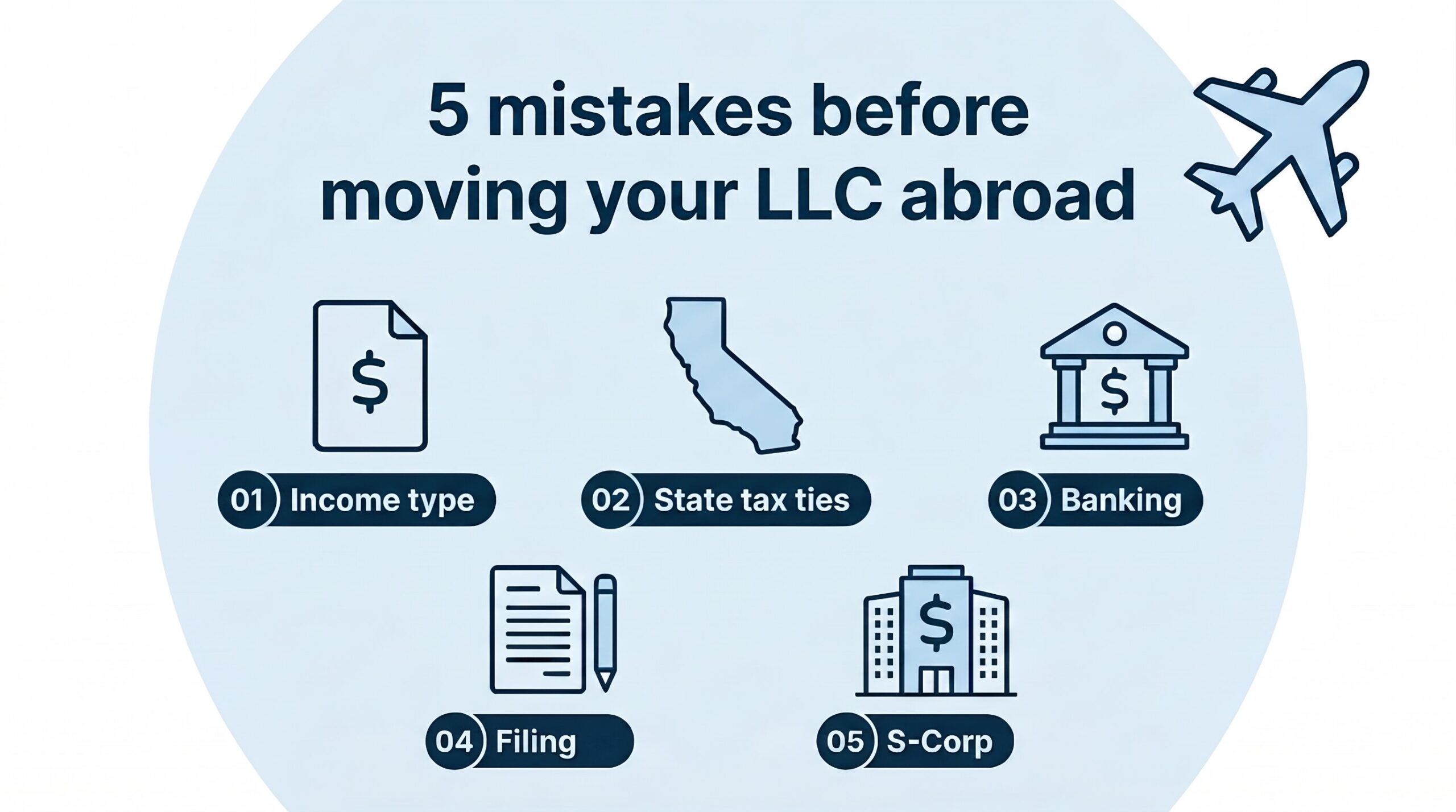
If you own a US LLC and you are about to move abroad, the next six months carry a level of tax risk most people do not see coming.
The assumption most LLC owners make is that moving is a personal change. The LLC stays registered in the US, the income keeps coming in, and everything continues the way it always has. That assumption is what makes these mistakes so expensive. By the time the consequences show up, usually at tax season one or two years after the move, reversing them is significantly harder than preventing them would have been.
These are the five mistakes we see most often. Every one of them is preventable before you leave.
This sounds basic. It is not.
The IRS treats three types of income differently, and how your LLC income gets classified determines almost everything about your tax position once you move abroad.
Active income is money you work for: consulting fees, agency revenue, e-commerce where you are actively running the business. Passive income arrives without active work: rental property income, royalties, certain investment returns. Portfolio income covers capital gains, dividends, and interest.
The reason this matters the moment you move abroad is the Foreign Earned Income Exclusion. The FEIE allows you to exclude up to $130,000 of foreign-earned income from US taxable income. It is one of the most valuable tools available to Americans abroad, and it only applies to active earned income. If your LLC produces rental income, the FEIE does not help you.
We have had clients move abroad assuming their entire rental portfolio would qualify for the exclusion. It does not. They planned their finances around one tax outcome and landed with a very different one.
Before you move: pull up your last tax return and look at your Schedule C or K-1. Identify what kind of income your LLC actually generated. If you are not certain whether it qualifies as active or passive, that uncertainty is the answer about whether you need a professional conversation before the flight.
This is the single most expensive mistake we see, and the most preventable.
California, New York, New Mexico, and Virginia are aggressive about claiming tax residency over people who move abroad. If your LLC is registered in one of these states, if you still hold a driver’s license there, maintain voter registration, have a US lease in your name, or list a state address as your permanent residence, the state can argue you never truly left. The result is state income tax for years after you moved.
We have seen clients pay California state tax for four years after relocating to Portugal because nobody walked them through how to cut those ties before the move. California’s top income tax rate exceeds 13%. New York City residents pay state and city combined. On $200,000 of income that is $25,000 to $30,000 per year you should not be paying.
The fix is not complicated, but it has to happen before you leave, not after. Establishing domicile in a new state before moving abroad, updating your driver’s license, changing your voter registration, and removing documentation that ties you to the high-tax state are the core steps. The specifics vary by state and by individual situation.
Before you move: check what state issued your driver’s license, what state your LLC is registered in, and where you are registered to vote. If all three point to a high-tax state, that is your first phone call before you book the flight.
The day you update your address to a foreign country, things start happening quietly in the background.
US banks have compliance programs that flag account holders living abroad. Some banks accommodate this without issue. Others do not, and they do not always notify you. The first sign is often an account review or restriction that appears without warning.
The payment processor problem is more acute. Stripe, PayPal, Mercury, and most US payment processors are built around US-based account holders. When they identify that the account operator is living abroad full-time, they can restrict or close the account. We have had clients lose weeks or months of business because their payment processing froze without warning.
The LLC itself is not the problem. You can operate a US LLC from Lisbon, Mexico City, or Bangkok indefinitely. The infrastructure underneath it, the banking and payment processing that assumes you are sitting in Ohio, is where the disruption happens.
Before you move: call your business bank directly and ask whether they allow account holders to operate the account while living abroad full-time. If the answer is not a clear yes, you have a banking transition to plan before you leave. Some providers such as Mercury and Relay tend to be more accommodating of expat operators. Most traditional US banks are not.
When you live in the US, an LLC return is straightforward. A single-member LLC files a Schedule C. A partnership files a 1065 with K-1s. You report income, take deductions, and file.
The day you move abroad, new forms get triggered. These are the ones most domestic CPAs miss, and they are the ones that carry the most serious penalties.
FBAR, the Foreign Bank Account Report, is required if your total foreign account balances exceed $10,000 at any point during the year. The failure-to-file penalty starts at $10,000 per account per year. This is separate from your tax return and filed through FinCEN, not the IRS.
Form 8938 requires reporting specified foreign financial assets above higher thresholds and is filed with your tax return. Filing FBAR does not satisfy the Form 8938 obligation.
Form 5471 is required if you own a foreign corporation. Form 8865 applies if you are in a foreign partnership. Form 2555 is the form you file to actually claim the FEIE. None of these exist on a domestic LLC return.
We have reviewed hundreds of returns where a domestic CPA filed the exact same return after a client moved abroad. Same Schedule C, same deductions, zero new international forms. The client believed they were compliant. They were not. They were simply not yet caught.
Before you move: ask your current CPA directly what new international forms apply to your situation now that you are moving abroad. If the response is confusion or a long pause, that tells you something important about whether this CPA is the right person to handle your return going forward.
When you operate a US LLC domestically, the tax planning logic is familiar. Single-member LLC, take owner’s draws. If the LLC is profitable, many domestic CPAs recommend an S-Corp election to reduce self-employment tax. For a US-based operator, that math often makes sense.
Abroad, it flips.
The S-Corp election that saves a domestic owner thousands in SE tax can quietly disqualify an expat from the FEIE. Here is why. S-Corp profit distributions are not classified as earned income. They do not qualify for the $130,000 FEIE. A client who moves abroad with an S-Corp election in place, following advice from a domestic CPA who did not account for the expat context, can lose years of FEIE benefits before understanding what happened.
We see this consistently. The client moves abroad. The domestic CPA recommends an S-Corp because it worked for their other clients. The expat loses FEIE eligibility on income that would otherwise have been fully excluded. The mistake compounds for as long as the election stays in place.
For most LLC owners moving abroad with business profit under approximately $250,000, the S-Corp election is the wrong move. The self-employment tax savings it produces domestically are outweighed by the FEIE benefits it costs you internationally.
Before you move: if a CPA is recommending an S-Corp election, ask them to model the FEIE impact explicitly. If they are not familiar with how the S-Corp election interacts with the FEIE for an expat, that interaction needs to be understood before any election is made.
Every one of these mistakes is preventable before the move. Every one of them becomes harder and more expensive to unwind after you have already left.
The move itself is one of the most consequential tax events of your life if handled without planning. It is also one of the most rewarding ones if handled correctly. The difference between those two outcomes is almost entirely determined by what happens in the weeks and months before the plane takes off.
Can I keep operating my US LLC after moving abroad?
Yes. The LLC itself can continue operating regardless of where you live. The complications arise in the areas around it: how the income is classified, whether state tax ties have been properly severed, how banking and payment processing responds to a foreign address, and what new filing obligations are triggered. The LLC continues; the tax picture around it changes significantly.
Does moving abroad affect my self-employment tax?
The FEIE excludes foreign-earned income from federal income tax but does not eliminate self-employment tax on active LLC income. However, some tax treaties between the US and specific countries affect SE tax obligations. Whether SE tax applies and how to manage it is a country-specific analysis worth understanding before the move.
What is the risk of not cutting state tax ties before moving?
States like California and New York apply a domicile test to determine whether someone has truly left for tax purposes. If you maintain significant connections to the state after moving abroad, including a driver’s license, voter registration, or property, the state may continue asserting taxing rights. The financial exposure depends on the state’s income tax rate and your income level, but for high earners in high-tax states it can be substantial and can accumulate over multiple years before it surfaces.
How do I know if my current CPA is equipped to handle my return after the move?
Ask them directly what new international forms your move triggers. A CPA experienced in expat taxation will immediately reference Form 2555, FBAR, and potentially Forms 5471 or 8938 depending on your situation. Hesitation or unfamiliarity with these forms is a signal that your return requires a specialist.
At what income level does the S-Corp election make sense for an expat LLC owner?
This depends on the specific interaction between the SE tax savings and the FEIE impact for your situation, but as a general directional answer: for most expat LLC owners earning under approximately $250,000 in active business income, the FEIE benefits lost through an S-Corp election outweigh the SE tax savings gained. Above that threshold the analysis becomes more nuanced. Run both scenarios explicitly before making any election.
If you are planning a move abroad with a US LLC and want to make sure you are handling these decisions correctly before you leave, this is the kind of planning conversation we have every day. Book a consultation and we will walk through your specific situation.
Filing US taxes as an American abroad is complex. We help make it easy for you.