Ready to seek assistance with your US taxes?
Filing US taxes as an American abroad is complex. We help make it easy for you.


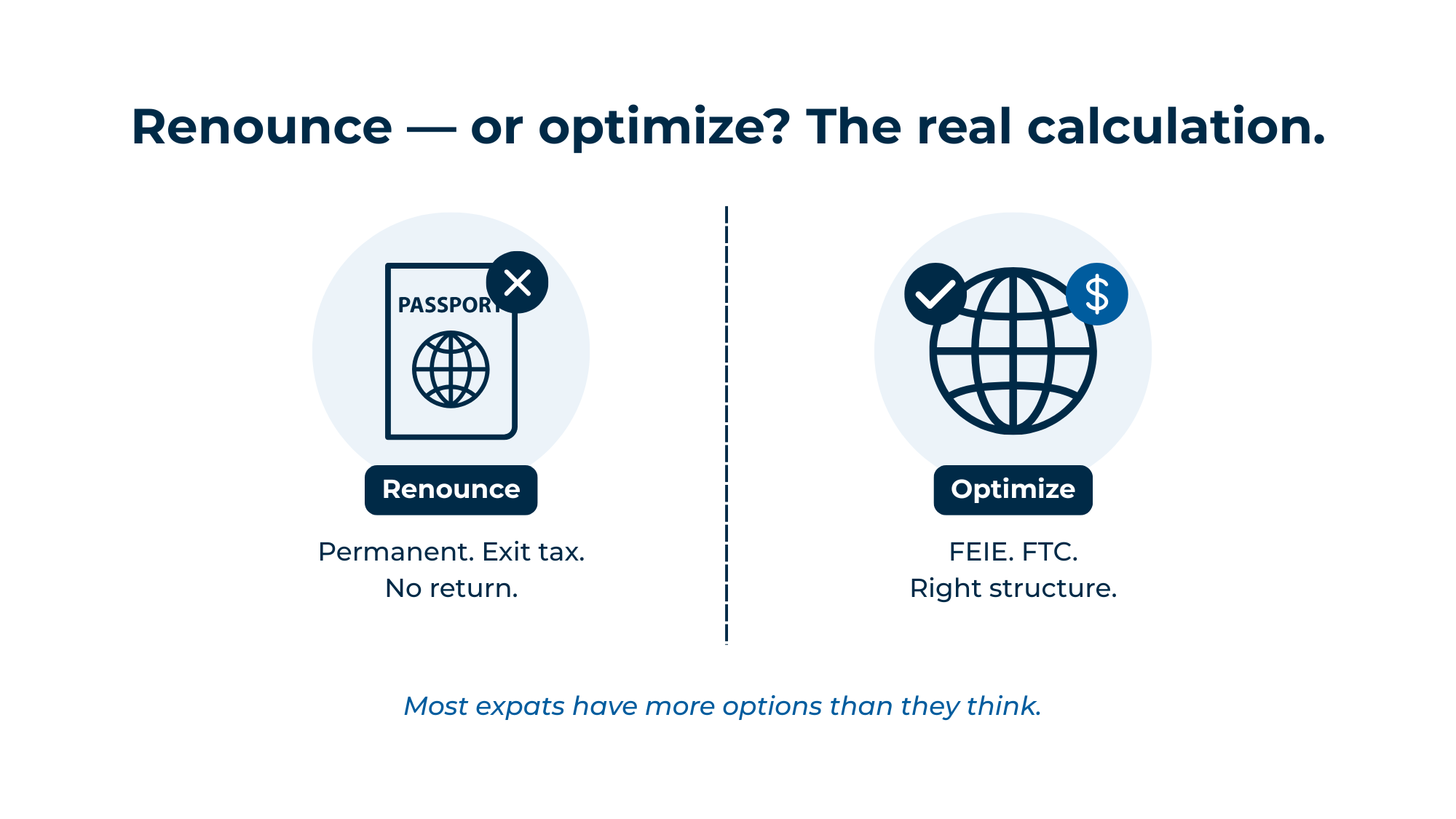

A lot of successful Americans are seriously considering renouncing their US citizenship right now. Higher taxes, more reporting, more restrictions. The idea of just being done with it has never been more popular.
I spent over three years seriously considering it myself. I had a second passport ready through Italian ancestry. I had the country picked. And in the end, I did not renounce.
Today I will explain exactly why, because for the vast majority of Americans thinking about this, there is a smarter path that gets you most of the financial benefit without giving up everything you would lose by renouncing.
Most people thinking about renouncing focus on the potential tax savings. They do not focus enough on what they are actually giving up.
You lose the right to live in the United States. Permanently.
If your life changes ten years from now and you want to come back, you cannot just come back. You apply for a visa like anyone else, and that visa can be denied. We have seen this happen. Clients renounce, then a parent gets sick and they need to be in the US to help. The door is now closed. They apply for a tourist visa, and if the consular officer decides the renunciation looks tax-motivated, the visa gets rejected.
US assets do not disappear.
If you keep US real estate, US investments, or US dividend-paying accounts, you still file a US tax return on that income. Renouncing does not make those obligations go away. It just makes the overall situation more complex to manage.
The Exit Tax can be substantial.
If you renounce and meet any one of the covered expatriate tests (net worth of $2 million or more, average annual US tax liability above $211,000 over the preceding five years, or failure to certify five years of compliance on Form 8854) the IRS treats you as having sold every asset you own the day before renunciation and taxes you on the gains.
For 2026, the first $910,000 of net unrealized gain is excluded. Only gains above that threshold are taxed. For someone with substantially appreciated assets, the bill can be enormous. For someone with modest unrealized gains, the actual tax owed can be zero even if they technically qualify as a covered expatriate.
Note: retirement accounts like IRAs and 401(k) s are not subject to the deemed sale rule. Instead, the IRS treats them as fully withdrawn the day before renunciation, taxing the entire balance as ordinary income.
This was the calculation that stopped me personally. I have US real estate. I have investments across multiple countries. I have family in the US. Renouncing does not eliminate any of those ties. It just makes them harder to manage.
Here is my own setup, and what we build for clients in similar situations.
I qualify for the Foreign Earned Income Exclusion, which lets me exclude approximately $130,000 of salary from US federal income tax each year. My business is structured offshore correctly, which brings my effective corporate tax rate to around 10% rather than the much higher US rate. I pay a modest amount of tax as a fiscal resident in my country of residence.
The combined effective tax rate across everything: approximately 10.5%. Legally. Fully reported. Compliant with every US filing obligation that applies to a citizen living abroad.
Compare that to renouncing. A US citizen with a similar setup might achieve zero local tax in a place like the UAE. But they pay the Exit Tax as a one-time cost, lose access to the US permanently, and lose the ability to invest or do business there cleanly. For most of our clients, when the math is done properly, the alternative structure outperforms renunciation.
There is another consideration that almost nobody in the online discourse about this mentions. The world is moving toward a global minimum tax. The OECD has been pushing 15% as the floor. Dubai moved from zero to 9%. Singapore is at 17%. Even the jurisdictions that built their appeal on zero tax are moving up.
The premise of renouncing to pay zero is a premise that is getting weaker every year. If you are going to end up paying 10 to 15% regardless of where you live, the value of renouncing permanently collapses. You have given up your citizenship for a benefit that is quietly disappearing.
That said, renunciation is the right call for some people. Here are the three situations where it genuinely makes sense.
1. You already have a strong second passport.
Not a citizenship-by-investment passport from a small island nation. A genuinely strong one: Canadian, Spanish, Irish, German, Italian, Australian, British. Something with broad visa-free access and real economic substance behind it. If you already have that, the practical cost of giving up the US passport is much lower.
2. Your life is genuinely no longer connected to the United States.
You do not live there. You do not have family you need to be near. You do not have major US-based business interests. You are not planning to return. If your only remaining relationship with the country is a tax obligation, the calculus changes meaningfully.
3. You are high-net-worth and have run the actual math.
For ultra-high-net-worth individuals with the right country of residence, the Exit Tax is a one-time event and the long-term tax savings can genuinely outweigh it. But this only holds after a careful, multi-year analysis of your assets, income types, treaty positions, and the Exit Tax calculation itself. It is not a conclusion you can reach from reading a blog post or watching a YouTube video.
If you do not meet all three of those criteria, the honest recommendation is to not renounce yet. Build the right structure first. Live abroad properly. Use the FEIE. Get the Foreign Tax Credits working for you. Get your second passport sorted if you do not already have one. Then revisit the renunciation question in three to five years with a clearer picture of your situation.
Most Americans seriously considering renunciation can achieve 80% of the financial benefit without renouncing at all, simply by structuring their situation correctly. The FEIE, the Foreign Tax Credit, the right business structure, and the right country of residence can produce an effective tax rate that rivals or beats what renunciation would produce, without the permanence, the Exit Tax cost, or the loss of access.
Renunciation is a real, legal option. For some people it is the right one. But it is permanent, it is expensive, and the tax case for it is getting weaker as the global minimum tax framework expands.
The smart move is to understand both paths, model both outcomes for your specific situation, and make a deliberate decision rather than a reactive one.
Is renouncing US citizenship legal?
Yes. Any US citizen has the right to renounce their citizenship. The process involves appearing in person at a US embassy or consulate, completing Form DS-4079, and paying the administrative fee. The fee was reduced from $2,350 to $450 effective April 2026.
Can I renounce citizenship to avoid paying taxes?
Tax-motivated renunciation is legal but is specifically addressed in the Exit Tax rules. The covered expatriate regime under Section 877A applies regardless of the reason for renunciation. Renouncing does not eliminate US tax on US-source income or on assets sold under the deemed-sale rule at the time of renunciation.
What is the covered expatriate threshold for 2026?
For 2026, you are a covered expatriate if your net worth is $2 million or more, your average annual US net income tax liability for the preceding five years exceeds $211,000, or you fail to certify five years of tax compliance on Form 8854. Any one of the three tests is sufficient.
How much is the Exit Tax exclusion in 2026?
The mark-to-market exclusion for 2026 is $910,000. This means the first $910,000 of net unrealized gain across all mark-to-market assets is excluded from the deemed-sale calculation. Gains above that threshold are taxed at applicable capital gains rates.
What happens to my IRA or 401(k) if I renounce?
Retirement accounts like IRAs and 401(k)s are not subject to the deemed-sale rule. Instead, the IRS treats them as if they were fully distributed the day before renunciation. The entire balance is included in income for that year and taxed as ordinary income, which can push the effective tax rate on those funds significantly higher than for other asset types.
Can I get US citizenship back after renouncing?
Renunciation of US citizenship is generally irrevocable. There is no standard reinstatement process. In very limited circumstances, someone who renounced as a minor may be able to reclaim citizenship, but for adults who renounce voluntarily, the decision is permanent.
If you are seriously considering renunciation, or if you want to understand what a properly structured alternative looks like for your specific situation, this is one of the most important conversations to have before making any irreversible decision. Book a consultation and we will model both paths.
Filing US taxes as an American abroad is complex. We help make it easy for you.