Ready to seek assistance with your US taxes?
Filing US taxes as an American abroad is complex. We help make it easy for you.


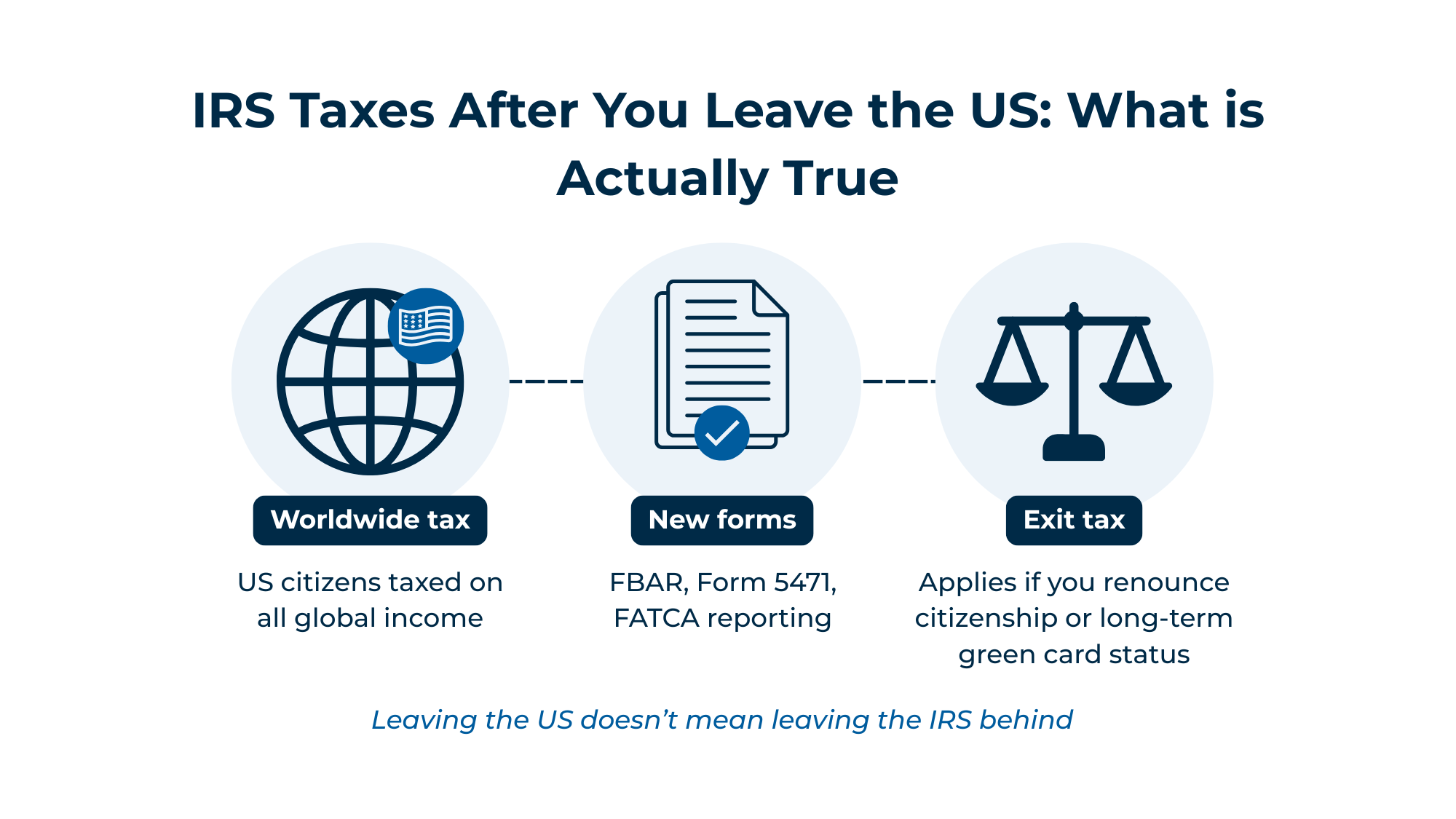

If you have spent any time on YouTube or in expat forums lately, you have probably seen some version of this claim: “The IRS will tax you for ten years after you leave the United States.” New law. Massive penalties. No escape.
Some of that is true. Most of it is exaggerated. And a meaningful portion of it is clickbait designed to scare you into making a hasty decision.
After fifteen years of running an international tax firm and working with Americans in over ninety countries, here is what is actually on the books, what is outdated, and what you should genuinely be planning for.
The ten-year tax claim traces back to Section 877 of the tax code, which did impose a ten-year regime on certain people who renounced citizenship if the IRS believed they renounced primarily to avoid tax. That rule was largely replaced in 2008 by a different system under Section 877A.
The new system is a one-time event, not a ten-year sentence. It is called the Exit Tax, and it applies at the moment of renunciation for qualifying individuals, not for ten years afterward.
So when someone tells you the IRS taxes you for ten years after you leave, they are describing a rule that was mostly retired before the iPhone 4 came out. The actual current rules are worth understanding on their own terms, and they are more nuanced than either the clickbait or the denial suggests.
1. The US taxes citizens on worldwide income for life
This is the foundation of everything else. The United States is one of only two countries in the world that taxes based on citizenship rather than residency. As long as you hold US citizenship, you are required to file a US tax return every year regardless of where you live. Move to Lisbon. Move to Dubai. Move anywhere. If you are a US citizen, the IRS expects a return.
This is not a new rule. It has been the law for over a century. But a large number of people moving abroad discover it only at their first tax season overseas, which is when the problems start accumulating.
2. The Exit Tax is real and significant for high earners
If you renounce US citizenship, the IRS may treat you as having sold every asset you own the day before you renounced and tax you on the gains. This is the Exit Tax under Section 877A.
It applies to what the IRS calls “covered expatriates.” For 2026, you are a covered expatriate if any one of three tests applies: your net worth is $2 million or more on the date of expatriation, your average annual US net income tax liability for the five preceding years exceeds $211,000, or you cannot certify five years of full tax compliance on Form 8854.
That last test is the one people most often miss. Failing to file Form 8854 makes you a covered expatriate automatically, regardless of your net worth or income level.
For covered expatriates, the Exit Tax is calculated on a deemed sale of worldwide assets. The first $910,000 of net unrealized gain is excluded for 2026. Only gains above that threshold are taxed, generally at capital gains rates. For someone with substantially appreciated assets this can be a very large bill. For someone with modest assets and limited unrealized gains, the actual tax owed can be zero even if they technically qualify as a covered expatriate.
The critical point: the Exit Tax is a one-time event at the moment of renunciation. Not a recurring ten-year obligation.
3. New forms get triggered the day you move abroad
This is where most people get blindsided, and it applies even if you keep your citizenship and have no intention of renouncing.
The moment you have foreign bank accounts, foreign businesses, or foreign assets, new IRS forms come into play. FBAR is required if your foreign accounts cross $10,000 in aggregate at any point during the year. Form 8938 covers specified foreign financial assets above higher thresholds. Form 5471 applies if you own a foreign corporation. Form 2555 is what you file to actually claim the Foreign Earned Income Exclusion.
The penalties for missing these forms start at $10,000 per form per year. We have reviewed hundreds of returns where a domestic CPA filed the same exact return after a client moved abroad, same Schedule C, same deductions, zero new international forms. The client believed they were compliant. They were not. They simply had not been caught yet.
Clickbait 1: “There is a new law that will tax you forever even after you renounce”
There have been proposals along these lines floated in Congress over the years. None have become law in the form the headlines suggested. When someone tells you a new law was passed, ask which bill, when it passed, and what section of the tax code. The answer is almost always that it was proposed, or discussed, or introduced in committee. Proposals are not laws.
Clickbait 2: “If you move abroad you will be double-taxed on everything”
This ignores three of the most important tools in the international tax code. The Foreign Earned Income Exclusion allows qualifying Americans to exclude up to $130,000 of earned income from US tax each year. The Foreign Tax Credit provides a dollar-for-dollar credit for taxes paid to a foreign government, preventing most actual double taxation. And tax treaties between the US and over sixty other countries provide additional relief on specific income types.
Are people who move abroad without using these tools sometimes double-taxed? Yes. Is double taxation an automatic consequence of moving abroad? No.
Clickbait 3: “Just renounce and you are free”
Renouncing US citizenship is real, legal, and sometimes the right call. It is also expensive, irreversible, and comes with the Exit Tax described above. It is a permanent decision with permanent consequences. The renunciation fee itself was reduced from $2,350 to $450 in April 2026, but the Exit Tax rules and Form 8854 filing requirements remain unchanged.
Anyone presenting renunciation as a quick fix is leaving out the most important parts.
Tax planning before the move
The most expensive mistake we see is people who move first and figure out the tax piece second. The timing of your move, your state of residence, your business structure, and the country you move to all interact in ways that determine your tax bill for years afterward. Some of these decisions are reversible after the fact. Most are not. Planning before the flight is orders of magnitude cheaper than fixing things after.
Understanding which tools actually apply to you
The FEIE works for some people and not others. The Foreign Tax Credit is better in some countries than others. Tax treaties differ significantly between countries. Renunciation makes sense for some clients and is completely wrong for others. There is no universal answer. There is only the right answer for your specific situation, which depends on your income type, your country of residence, your assets, and your long-term goals.
Working with someone who actually handles international tax
Most CPAs do not handle the international piece. A domestic accountant who files the same return year after year after a client moves abroad is not negligent in the traditional sense. They are simply out of their depth in a specialty area they were not trained for. The difference between a generalist and an international tax specialist is the difference between leaving significant money on the table and not.
The IRS does follow US citizens around the world for life through citizenship-based taxation. The Exit Tax is real and applies to covered expatriates at the moment of renunciation. The new forms triggered by living abroad are real and carry serious penalties if missed.
But most of the viral content about this topic is exaggerated, outdated, or designed to provoke a reaction rather than inform a decision. The smart path is to understand the actual rules, plan around them deliberately, and not let online panic drive you into either inaction or the wrong decision.
Does the IRS really tax US citizens for ten years after they leave?
The old Section 877 rule did impose a ten-year tax regime on certain expatriates, but it was largely replaced in 2008 by Section 877A, which imposes a one-time Exit Tax at the moment of renunciation rather than a ten-year ongoing obligation. The “ten-year tax” claim describes a rule that is mostly outdated.
Who is subject to the Exit Tax?
The Exit Tax under Section 877A applies to covered expatriates: US citizens who renounce, or long-term green card holders who give up their status, and who meet at least one of three tests. For 2026, those tests are: net worth of $2 million or more, average annual US tax liability exceeding $211,000 over the preceding five years, or failure to certify five years of tax compliance on Form 8854. Meeting any one of the three tests triggers covered expatriate status.
If I move abroad but keep my citizenship, do I still owe US taxes?
Yes. The US taxes citizens on worldwide income regardless of where they live. Moving abroad does not change the filing obligation. What changes is which tools are available to reduce or eliminate double taxation, including the FEIE, the Foreign Tax Credit, and applicable tax treaties.
What forms do I need to file after moving abroad?
Beyond your regular Form 1040, the most common additional forms for Americans abroad are Form 2555 for the FEIE, Form 1116 for the Foreign Tax Credit, FinCEN Form 114 for FBAR, and Form 8938 for specified foreign financial assets. Form 5471 applies if you own a foreign corporation. The specific forms required depend on your income, assets, and country of residence.
What is the renunciation fee in 2026?
The US State Department reduced the renunciation fee from $2,350 to $450, effective April 13, 2026. This change does not affect Exit Tax rules, covered expatriate thresholds, or Form 8854 filing requirements.
If you are planning a move abroad, or if you have been living outside the US and are not sure whether your filing situation is fully handled, this is the kind of conversation we have every day. Book a consultation and we will walk through your specific situation.
Filing US taxes as an American abroad is complex. We help make it easy for you.