
Ready to seek assistance with your US taxes?
Filing US taxes as an American abroad is complex. We help make it easy for you.


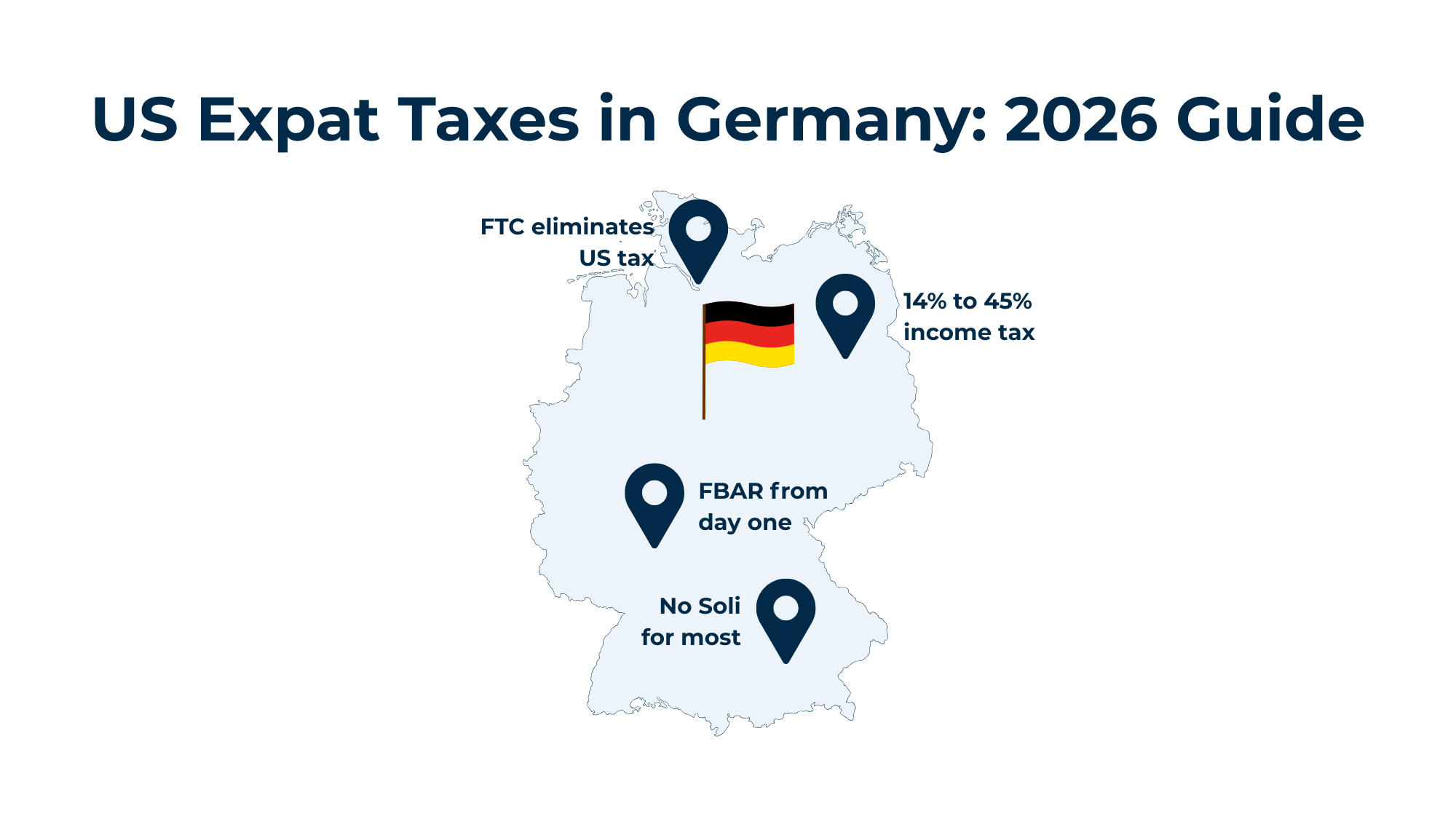
Germany is one of the most popular destinations for American expats in Europe. Strong economy, excellent infrastructure, world-class cities, and a straightforward path to long-term residency. Germany’s high tax rates often come with an unexpected advantage for many Americans: paying more in Germany often reduces, and sometimes eliminates, their US federal income tax bill.
This guide covers the German tax system for 2026, how the FEIE and Foreign Tax Credit interact with German taxes, FBAR and reporting obligations, the US-Germany tax treaty, the Totalization Agreement, and the situations that catch Americans in Germany off guard most often.
Yes. Moving to Germany does not end your US filing obligation. US citizens and most green card holders must generally file a US tax return if their worldwide income exceeds the applicable filing threshold. How much income triggers a filing requirement generally depends on your age and filing status. Although some rules kick in much sooner. For instance, if you’re self-employed, the threshold is much lower. Self-employed individuals generally must file once they have at least $400 in net earnings.
What changes when you move to Germany is not whether you file, but how you file and which tools are available to reduce what you owe. In most cases, the combination of German taxes paid and the Foreign Tax Credit may eliminate your US federal tax liability entirely. The result generally depends on the type and source of the income, the applicable Foreign Tax Credit limitation, and whether other US taxes apply. Either way, the filing obligation remains.
Germany taxes its residents on worldwide income. You become a German tax resident if you spend more than six months in Germany in a calendar year, or if you have a habitual place of abode in Germany on December 31 of that year.
Germany uses a progressive income tax system. For 2026, the basic tax-free allowance (Grundfreibetrag) is €12,348. Above that, rates rise progressively from 14% reaching 42%. . There’s also a top rate of 45%, often called the Reichensteuer, that applies to income above€277,825.
Two additional levies can apply in certain situations.
The solidarity surcharge (Solidaritätszuschlag) is calculated as a percentage of German income tax, not directly on income. It was originally 5.5% of income tax across the board. Since 2021 it has been abolished for most taxpayers. In 2026, it only applies where income tax liability exceeds €20,350 for single filers, roughly equivalent to income above €66,000. High earners still pay it. Most expats with moderate incomes do not.
Church tax applies if you are registered as a member of a recognized church in Germany. It is 8% of income tax in Bavaria and Baden-Württemberg, and 9% elsewhere. It is automatically deducted by German employers. Americans moving to Germany who are not members of a German church can typically avoid this by not registering with one.
Germany’s investment income is taxed separately through the Abgeltungsteuer, a flat 25% withholding tax on dividends, interest, and capital gains from securities. Including the solidarity surcharge, the combined effective rate is 26.375%. German banks apply this tax automatically at source. US expats must also report the same investment income on their US return and can claim the German tax withheld as a Foreign Tax Credit on Form 1116.
For most Americans in Germany, the Foreign Tax Credit is the better choice. Understanding why requires understanding the gap between German and US tax rates. Because German income tax rates are often higher than their US equivalents, the Foreign Tax Credit generally reduces the US tax bill to zero or close to it. If the available German tax exceeds the US credit limitation, unused credits are not refunded; instead they can be carried back one year or forward for up to ten years.
The Foreign Earned Income Exclusion works differently. It excludes up to $132,900 of foreign-earned income from US taxable income in 2026. For a US expat in Germany earning below that threshold, the FEIE can also produce zero US tax. But there are two important drawbacks in the German context.
First, the FEIE does not apply to passive income. Rental income, dividends, and capital gains remain on your US return regardless of the FEIE. The Foreign Tax Credit can offset German taxes on those categories. The FEIE cannot.
Second, using the FEIE limits your ability to contribute to an IRA. If all your earned income is excluded, you have no remaining earned income on which to base an IRA contribution. For expats who want to continue contributing to US retirement accounts, the Foreign Tax Credit preserves that option in a way the FEIE does not.
There are situations where combining both tools makes sense. Using the FEIE on earned income up to the threshold and the Foreign Tax Credit on income above it, or on passive income, can in some cases produce a better outcome than either tool alone. The right approach depends on your income level, income composition, and whether you have passive income alongside your earned income.
One important rule: you cannot switch between the FEIE and the Foreign Tax Credit freely. If you have previously claimed the FEIE and choose to revoke it in favor of the FTC, you generally cannot reclaim the FEIE for five years without IRS approval. This decision should be made deliberately rather than by default.
Opening a German bank account does not automatically trigger an FBAR requirement.
You are required to file an FBAR if the aggregate value of all your foreign financial accounts exceeds $10,000 at any point during the calendar year. The threshold is aggregated across all accounts, not per account. German checking accounts, savings accounts, brokerage accounts, Bausparverträge (building savings contracts), and investment depot accounts all count toward the threshold.
German pension plans including Riester and Rürup may also require FBAR reporting depending on their structure. This is worth confirming with your tax advisor in your first year.
A practical note on banking in Germany: some German banks decline US citizen applications due to FATCA reporting requirements. N26 and Deutsche Bank’s international services have been more accommodating for US citizens. You will be asked for your US Social Security number or taxpayer identification number when opening an account. This is a FATCA requirement and refusing to provide it can result in the account not being opened.
Form 8938 is also required if your foreign financial assets exceed $200,000 at year-end (or $300,000 at any point during the year) for single filers, or $400,000 at year-end (or $600,000 at any point) for married filing jointly. This is filed with your tax return and is separate from FBAR.
While these are informational forms and do not generate any additional tax in the US, failure to file or filing incorrectly generally carries heavy penalties so it’s important you stay up to date with these filings.
The United States and Germany have a comprehensive tax treaty that affects how specific types of income are taxed between the two countries. For most employed Americans in Germany, the Foreign Tax Credit provides the main protection against double taxation, but certain provisions are worth knowing.
Under the treaty, interest income is generally taxed in the country where the taxpayer resides. Dividends are subject to reduced withholding rates in certain circumstances. Business profits are taxed in the country where the activity occurs unless it operates through a permanent establishment, such as a fixed place of business, in the other country.
The treaty also includes specific provisions for certain categories of individuals. Qualifying students or professors who move temporarily to Germany may receive an exemption from German tax on that income for up to two years. Pension income has specific treaty treatment depending on whether the pension is a government pension, a private pension, or a social security payment.
German pension plans, specifically Riester and Rürup plans, deserve a separate mention. Neither is recognized as tax-qualified by the IRS. Contributions to these plans are not US-deductible, and the growth inside them is generally not tax-deferred for US purposes. The US-Germany treaty does not extend favorable Article 18A coverage to Riester or Rürup. Many US expats in Germany avoid these products and contribute to US retirement accounts such as IRAs instead.
For complex treaty positions, particularly those involving business income, pensions, or dual-residency situations, Form 8833 is used to disclose treaty-based return positions on your US return.
The US-Germany Totalization Agreement addresses social security taxes specifically. Its purpose is to prevent Americans in Germany from paying social security taxes on the same income to both countries simultaneously.
If your US employer sends you to Germany on an assignment, your employer will generally continue paying US Social Security taxes for the duration of the assignment, typically up to five years. You would not pay into the German social security system during that period. A certificate of coverage from the relevant authority confirms the exemption.
If you are employed by a German employer, you contribute to the German social security system rather than US Social Security. This means you are not accumulating US Social Security credits on that income.
For self-employed Americans in Germany, the agreement can be particularly valuable. US self-employment tax is 15.3% on top of income tax. If you obtain a certificate of coverage from the German authorities confirming that you pay into the German social security system, you can avoid the 15.3% US self-employment tax on that income. This is one of the most meaningful practical benefits of the Totalization Agreement for self-employed expats and is worth addressing in your first year in Germany.
US citizens who own 10% or more of a German company may have additional US reporting obligations beyond their personal return.
Form 5471 is required for US shareholders who acquire 10% or more of a foreign corporation, are officers or directors of one, or meet certain other criteria. The form is informational but carries penalties of $10,000 per year for failure to file.
If the German company qualifies as a Controlled Foreign Corporation, meaning US shareholders collectively own more than 50% of the voting power or value, NCTI rules may apply. NCTI replaced GILTI on January 1, 2026 under the One Big Beautiful Bill Act. As a high-tax country, Germany’s corporate tax rate of 15% plus the solidarity surcharge may push the effective local rate above the approximately 14% high tax exclusion threshold, potentially eliminating NCTI exposure entirely. This is worth analyzing with a specialist. Our full guide on the GILTI to NCTI transition covers this in detail.
German residents file their annual income tax return (Einkommensteuererklärung) for the calendar year. The standard filing deadline for the 2025 tax year is July 31, 2026, extendable to February 28, 2027 if filed through a tax advisor. Germany and the US both follow the calendar year, which simplifies the process of reconciling taxes paid in both countries for the purpose of the Foreign Tax Credit.
US filing deadlines remain unchanged for Americans abroad: June 15 automatic extension for expats, with a further extension to October 15 available by filing Form 4868.
Using the FEIE when the FTC would produce a better outcome. The FEIE is more familiar and feels simpler. In Germany, the FTC almost always wins because German taxes fully offset US liability and generate carry-forward credits. Defaulting to the FEIE wastes the German taxes paid.
Assuming the solidarity surcharge applies universally. Since 2021, it does not apply to the majority of taxpayers. If your income tax liability is below €20,350 as a single filer, you pay no solidarity surcharge. The article you may have read two years ago that said “Germany imposes 5.5% on all taxpayers” was outdated before you finished reading it.
Missing Riester or Rürup reporting obligations. These popular German pension vehicles are not recognized as tax-qualified by the IRS. Growth inside them is generally taxable in the US as it accrues. Many expats contribute to Riester plans through their employer without realizing the US tax implications.
Overlooking the Totalization Agreement for self-employment tax. The 15.3% US self-employment tax is one of the largest potential tax costs for self-employed Americans abroad. The agreement can eliminate it entirely for those who obtain the certificate of coverage and contribute to the German system instead.
Not addressing German bank account FBAR obligations in year one. Opening a German bank account is one of the first things people do when they arrive. FBAR obligations start immediately once the aggregate threshold is crossed. Missing the first year is one of the most common compliance gaps we see.
Is the FEIE or the Foreign Tax Credit better for Americans in Germany?
For most Americans in Germany, the Foreign Tax Credit produces a better outcome because Germany’s income tax rates consistently exceed the equivalent US rates. The FTC offsets US tax dollar-for-dollar using German taxes already paid, often producing zero US federal tax liability with excess credits to carry forward. The FEIE may be appropriate in specific situations, particularly for lower earners or those who want to structure only part of their income. Running both calculations before choosing is always worth doing.
Do I have to pay the solidarity surcharge as an American in Germany?
Only if your income tax liability exceeds €20,350 as a single filer in 2026. Since 2021, the solidarity surcharge has been abolished for approximately 90% of taxpayers. Most expats with moderate incomes in Germany pay no Soli. High earners still pay the 5.5% surcharge on their income tax.
Are Riester or Rürup pensions tax-efficient for US citizens?
Generally no. Neither plan is recognized as tax-qualified by the IRS. Contributions are not US-deductible, and growth inside these plans is generally taxable in the US as it accrues. Many US expats in Germany avoid these vehicles and contribute to US-based retirement accounts instead.
What is the Totalization Agreement between the US and Germany?
It is an agreement that prevents Americans in Germany from paying social security taxes to both countries on the same income. Depending on whether you work for a US or German employer, and how long your assignment is, either US Social Security or the German system applies, but not both. For self-employed Americans, obtaining a certificate of coverage from Germany can eliminate the 15.3% US self-employment tax.
Can I open a German bank account as a US citizen?
Yes, though some traditional German banks decline US citizen applications due to FATCA compliance obligations. N26 and Deutsche Bank’s international services are generally more accommodating. You will need to provide your US Social Security number or taxpayer identification number when opening an account.
Do I have to file FBAR for my German bank accounts?
Yes, if the aggregate value of all your foreign financial accounts exceeds $10,000 at any point during the year. This includes German checking accounts, savings accounts, brokerage accounts, and potentially pension accounts depending on their structure.
If you are living in Germany or planning to move there and want to confirm your US and German tax obligations are properly covered, this is one of the most common situations we handle. Book a consultation and we will walk through your specific situation.
Filing US taxes as an American abroad is complex. We help make it easy for you.