Ready to seek assistance with your US taxes?
Filing US taxes as an American abroad is complex. We help make it easy for you.


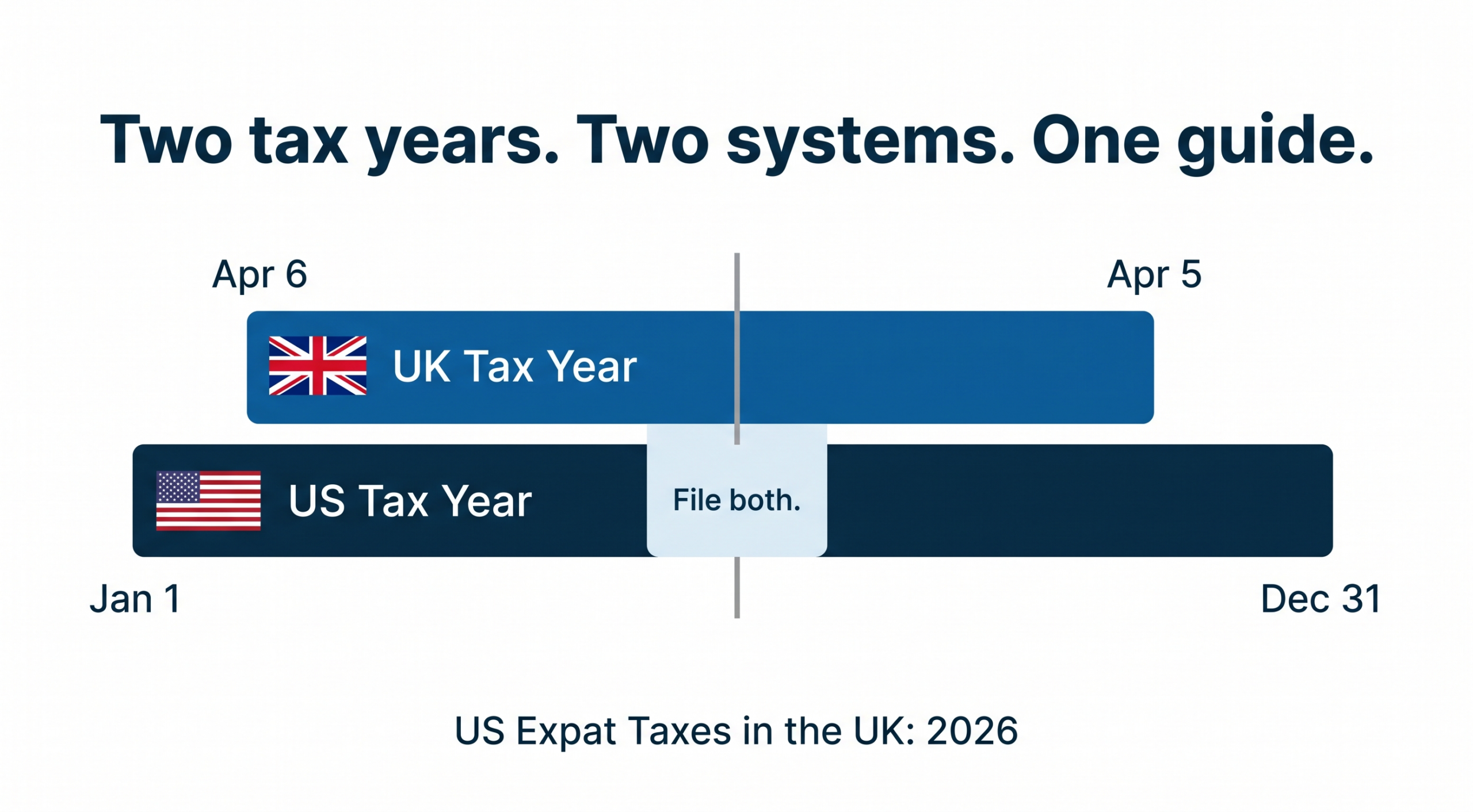

The UK is one of the most popular destinations for Americans moving to Europe. It is also one of the most complex from a tax perspective, because both countries tax comprehensively and because the UK’s rules changed significantly in April 2025.
The non-domicile regime that many long-term US residents in the UK had relied on was abolished. A new Foreign Income and Gains regime replaced it. HMRC issued new guidance on US pension lump sums. UK inheritance tax shifted from a domicile-based to a residency-based system.
For Americans arriving in the UK now, or those who have been there for years, the planning environment is different from what it was two years ago.
This guide covers the key US and UK tax considerations for Americans living in the UK in 2026, including the new FIG regime, how the FEIE and Foreign Tax Credit work in the UK context, ISAs and pensions, FBAR, the US-UK treaty, and the situations that catch Americans in the UK most off guard.
Yes. The US taxes its citizens on worldwide income regardless of where they live. Moving to the UK does not end your US filing obligation. A US federal income tax return is generally required when the individual meets the applicable filing requirements, which depend on filing status, age, gross income, self-employment income and other circumstances. For example, an individual with at least $400 of net self-employment earnings generally has a filing requirement even if their income is below the normal gross-income filing threshold. Also, note that separate international information-reporting obligations may also apply even when no US income tax return is required.
What changes when you move to the UK is how you file and which tools are available to reduce what you owe. The combination of the UK’s tax rates and the Foreign Tax Credit typically reduces or eliminates US federal tax liability for most employed Americans in the UK. But the filing obligation itself remains.
The UK generally taxes its residents on worldwide income, unless a specific exemption or relief applies, including the four-year Foreign Income and Gains regime for qualifying new residents. You become a UK tax resident if you spend 183 days or more in the UK during a UK tax year (April 6 to April 5 the following year). If you spend fewer days, the Statutory Residence Test determines whether you are resident based on ties: owning a home in the UK, having family there, or working there.
UK income tax rates for the 2026/2027 UK tax year are progressive. The personal allowance is £12,570. Income above the allowance is taxed at 20% (basic rate), 40% (higher rate above £50,270), and 45% (additional rate above £125,140). Scottish residents pay slightly different rates set by the Scottish Parliament. National Insurance contributions add further deductions for employed and self-employed workers.
The most significant UK tax change for Americans in recent years came into effect on April 6, 2025: the abolition of the non-domicile regime.
Under the old rules, individuals who were resident in the UK but not domiciled there could choose to pay UK tax only on foreign income and gains that they brought into the UK, known as the remittance basis. This was particularly relevant for Americans who had foreign investments, US brokerage accounts, or US rental income they could leave untouched abroad and pay no UK tax on it.
That option is gone for new income and gains arising from April 6, 2025 onward.
In its place, the UK introduced the Foreign Income and Gains regime. The FIG regime applies to individuals who become UK tax residents after not having been a UK resident for at least 10 consecutive tax years. For the first four UK tax years of residence, qualifying individuals can elect to pay zero UK tax on their foreign income and gains, regardless of whether those amounts are brought to the UK.
For Americans newly arriving in the UK who qualify for the FIG regime, this is a significant benefit. Eligible US income such as rental income, capital gains or investments can be sheltered from UK tax for the first four years. However, claiming the FIG regime means losing the UK personal allowance and the annual capital gains exempt amount in the years the election is made. The decision to claim it requires careful modelling, particularly given that the FIG income is still reportable to the IRS on the US return.
For Americans who have already been in the UK for more than four years, or who do not qualify for the FIG regime, the new worldwide income rules apply from April 2025. Foreign income and gains are now subject to UK tax in full for UK residents who do not qualify for the transitional or FIG provisions, subject to any applicable reliefs and treaty provisions.
A Temporary Repatriation Facility is available for those who were former remittance basis users. Qualifying pre-April 2025 foreign income and gains can be brought into the UK at a reduced flat rate: 12% in 2025/26 and 2026/27, rising to 15% in 2027/28. This is significantly lower than standard income tax rates of up to 45%, but it comes with an important catch for Americans: the UK does not give credit for US taxes already paid on the same income when using the Temporary Repatriation Facility. Double-tax exposure is a genuine risk and requires careful analysis before acting.
For most Americans in the UK, the Foreign Tax Credit is often the better choice because UK income tax can be high enough to cover the US income tax on the same earnings. The UK’s income tax rates start at 20% for basic rate taxpayers and can go as high as 45% for additional rate taxpayers. The FTC offsets US income tax dollar-for-dollar using UK taxes already paid or accrued, subject to limits, typically producing zero US federal tax owed with excess credits carrying forward for up to ten years and available to be carried back one year.
The Foreign Earned Income Exclusion excludes up to $132,900 of foreign-earned income from US taxable income in 2026, if you qualify for the full year. It can also produce zero US federal tax in many situations, but there are several reasons why the FTC is often the better long-term choice for UK-based Americans.
The FEIE does not apply to passive income. UK rental income, UK dividends, and UK investment gains remain subject to US tax rules regardless of the FEIE election. The FTC can offset UK taxes on all income categories.
The FEIE can limit IRA contribution eligibility. To contribute to an IRA, the rules generally say that you must have earned taxable income. If all your earnings are excluded, you have no remaining taxable compensation on which to base a traditional or Roth IRA contribution. For Americans who want to continue contributing to US retirement accounts while living in the UK, the FTC preserves that option.
The UK tax year runs from April 6 to April 5, while the US uses the calendar year. When using the FTC, UK taxes need to be allocated to the correct US tax year. A P60 covering the UK 2025/26 tax year includes pay and taxes from both the 2025 and 2026 US calendar years. Careful allocation between the two US returns is required when using UK taxes as FTC credits.
Combining both tools is sometimes the most efficient approach. Using the FEIE on earned income up to the threshold and the FTC on eligible passive income or income above the threshold can in some situations produce a better result than either tool alone.
One important rule: once you claim the FEIE and then revoke it in favor of the FTC, you generally cannot reclaim the FEIE for the next five years without IRS approval. This decision is worth making deliberately.
For Americans in the UK earning above the FEIE threshold, the Foreign Housing Exclusion or Deduction is worth knowing about. London is one of the most expensive rental markets in the world, and the housing exclusion can provide meaningful additional relief.
The standard housing exclusion limit is 30% of the FEIE threshold ($39,870 for 2026). However, the IRS publishes location-specific limits for expensive cities. For instance, the limit is $68,600 for London and $44,200 for most other UK locations.The qualifying expenses include rent, utilities, and certain furnishings. The exclusion is claimed on Form 2555 alongside the FEIE.
The Individual Savings Account (ISA) is one of the most popular investment vehicles in the UK. UK residents pay no income tax or capital gains tax on returns inside an ISA. However, the US doesn’t recognize this tax exemption.
For US citizens in the UK, the income earned inside an ISA is still reportable to the IRS. Dividends, interest, and realized capital gains inside the ISA are included in US taxable income regardless of the UK tax-free status, and even if the money remains in the account.
The PFIC problem can even be more serious. Many investment funds available inside UK Stocks and Shares ISAs are non-US funds that qualify as Passive Foreign Investment Companies (PFICs) under US tax rules. PFIC investments generally face a punitive US tax regime including interest charges and a special tax calculation that can produce effective rates significantly higher than ordinary income tax rates. Besides, a separate Form 8621 must be filed for each PFIC held, which can significantly increase the tax burden in the US. It’s also worth noting that certain exceptions may apply to the Form 8621 filing requirement.
Cash ISAs are treated differently. They are generally not PFICs. The interest earned inside a Cash ISA is simply taxed at ordinary US income tax rates, plus the Net Investment Income Tax where applicable. For some Americans in the UK, restricting ISA holdings to cash or finding ISA-eligible non-PFIC investments is a more tax-efficient approach than holding standard UK-managed funds.
HMRC has recently proposed changes to ISA rules, including lower annual cash ISA contribution limits for savers under 65 years old from April 2027 and restrictions on holding cash in non-cash ISAs. Americans with ISAs should monitor these developments as they may affect the investment options available inside the account going forward.
UK pensions are one of the most complex areas of US-UK cross-border taxation, including how HMRC interprets the treaty’s rules on lump-sum payments..
Workplace pensions and self-invested personal pensions (SIPPs) have different US treatment depending on who contributes, whether employer contributions are involved, and how and when funds are drawn. The UK State Pension follows separate treaty rules.
Employer contributions into a UK workplace pension can be excluded from US taxable income in the year of contribution under the US-UK tax treaty. Investment growth inside the pension is generally not subject to US tax as it accrues. This protection is one of the most valuable provisions of the US-UK treaty for employed Americans.
The 25% tax-free lump sum that UK rules allow on retirement is a common surprise. It may be tax-free under UK law but can be taxable by the IRS. The treaty does not always extend US recognition to this lump sum. Treatment depends on the specific type of pension, the nature of payment and the treaty provisions applicable.
US pension lump sums received by UK residents have also become more complex following new HMRC guidance issued in September 2025 and require careful review. Prior to this guidance, US pension lump sums were fully taxable in the US and excluded from UK tax. HMRC’s updated position is that these lump sums are also taxable in the UK, with the US taxes paid available as double taxation relief. For additional rate UK taxpayers, this may mean paying 37% US tax and 8% UK tax (the difference between the 37% US rate and the 45% UK rate) on such lump sum payments. This is a significant change for Americans in the UK drawing from US retirement accounts.
From April 6, 2025, the UK shifted its inheritance tax system from domicile-based to residence-based.
Under the old system, UK-domiciled and deemed UK-domiciled individuals paid UK inheritance tax on worldwide assets. A US citizen who moved to the UK but retained a US domicile could, in many cases, shelter non-UK assets from UK inheritance tax.
Under the new system, after 10 years of UK residency, an individual becomes a Long-Term Resident and is subject to UK inheritance tax on worldwide assets at 40%. For the first 10 years of UK residency, IHT applies only to UK-based assets.
For Americans who have recently moved to the UK, this can create a planning window. For those approaching or past the 10-year mark, reviewing their estate and inheritance position against both US estate tax rules and the new UK IHT framework is now genuinely important.
As a US citizen with UK bank accounts, FBAR obligations can apply from your first year in the UK – or even before you move, if you already hold foreign accounts and meet the reporting threshold.
You are required to file an FBAR if the aggregate value of all your foreign financial accounts exceeds $10,000 at any point during the calendar year. UK current accounts, savings accounts, investment accounts, ISAs, and SIPPs generally all count toward the threshold. Joint accounts with a UK spouse are reportable at the full balance.
UK financial institutions report certain US citizen account information to HMRC under FATCA, which in turn shares it with the IRS. Non-compliance is more easily detected in the UK than in many other jurisdictions because of this information-sharing infrastructure.
Form 8938 may also be required if your foreign financial assets exceed $200,000 at year-end or $300,000 at any point during the year for single filers abroad, with double those thresholds for married filing jointly. Filing an FBAR does not satisfy the Form 8938 obligation.
Lastly, while the 8938 is part of your tax return, the FBAR is filed separately with FINCEN.
The US and UK have a comprehensive tax treaty that addresses how specific income types are taxed between the two countries. The treaty includes a unique provision sometimes called the “super-credit,” which allows the FTC to be applied against US tax on UK income in a way that is more favorable than the standard FTC calculation in some situations.
Key treaty provisions for Americans in the UK include pension treatment, reduced withholding on dividends and interest in certain circumstances, and treaty-based protection for government pensions. Form 8833 is used to disclose treaty-based positions on the US return, although some claims are exempt from this disclosure requirement.
The US-UK Totalization Agreement prevents covered Americans workers in the UK from paying social security taxes to both countries on the same earnings.
If you work for a US employer and are sent to the UK on assignment, expected to last five years or less, you generally continue paying US Social Security and Medicare taxes and are exempt from UK National Insurance during that assignment.
If you work in the UK for a UK employer, you pay into the UK National Insurance system and are exempt from US Social Security and Medicare taxes on that employment income.
For self-employed Americans in the UK, this agreement is particularly valuable. US self-employment tax is 15.3% on top of income tax. Obtaining a UK certificate of coverage confirming that you pay into the UK National Insurance system exempts you from this 15.3% charge on the same income.
The UK tax year runs from April 6 to April 5. UK Online Self Assessment returns are generally due January 31 following the end of the tax year. The US tax year runs on the calendar year, with the June 15 automatic extension for expats and a further extension to October 15 available by requesting it on time using Form 4868.
For Americans using the Foreign Tax Credit, filing the UK return first provides the UK tax figures needed to complete Form 1116 on the US return. If the UK return is not yet complete by the US filing deadline, it is generally advisable to make an estimated payment of any US tax due by April 15 to stop interest accruing, and then file the full US return once UK figures are available.
While the US grants expats an automatic extension to file, it doesn’t apply to an extension for payment.
Using the FEIE when the FTC would produce a better outcome. The UK’s high tax rates mean the FTC is often the most beneficial for employed Americans. Defaulting to the FEIE forfeits the excess credits that carry forward.
Assuming ISA investments are US tax-free. They are not. UK tax-free status does not transfer to the US return. Funds inside a Stocks and Shares ISA may also be PFICs.
Not accounting for the non-dom changes. Americans who moved to the UK before 2025 and relied on the remittance basis for foreign income no longer have that option. The new worldwide income rules apply from April 2025.
Misunderstanding the FIG regime. The FIG regime is valuable for new arrivals but requires electing it and losing the personal allowance in the years it is claimed. The net benefit depends on the individual’s income composition and the value of the foreign income sheltered.
Not reviewing pension treatment before drawing funds. The 25% UK tax-free lump sum may not be tax-free in the US. US pension lump sums received in the UK are now also subject to UK tax under the September 2025 HMRC guidance.
Ignoring the new inheritance tax system. The shift to residence-based IHT from April 2025 has significant implications for Americans who have been in the UK for close to or more than 10 years.
Is the FEIE or the Foreign Tax Credit better for Americans in the UK?
For most employed Americans in the UK, the Foreign Tax Credit produces a better outcome. UK income tax rates exceed equivalent US rates in most situations, producing FTC credits that fully offset US liability with excess carrying forward. The FEIE may be appropriate in specific situations, particularly for lower earners or those whose income composition makes the FEIE more efficient. Running both calculations before choosing is always worthwhile.
What happened to non-dom status for Americans in the UK?
The UK remittance basis was abolished for new income and gains arising from April 6, 2025. The ability to pay UK tax only on foreign income brought into the UK no longer exists for income arising after that date. A new FIG regime provides four years of zero UK tax on foreign income and gains for newly arriving UK residents who qualify, but it requires an election and comes with conditions.
Are UK ISAs tax-free for US citizens?
No. ISAs are tax-free under UK rules but not under US rules. Income inside an ISA is still reportable to the IRS. Funds inside a Stocks and Shares ISA may qualify as PFICs under US tax rules, which carry a punitive US tax regime. Cash ISAs are simpler: the interest is taxed at ordinary US income tax rates, plus Net Investment Income Tax, where applicable.
What is the UK FIG regime and does it help Americans?
The Foreign Income and Gains regime applies to new UK residents who have not been UK resident for the previous 10 years. For the first four UK tax years, they can elect to pay zero UK tax on foreign income and gains. For Americans who qualify, this can shelter US investment income, rental income, and capital gains from UK tax during the first four years. However, claiming it means losing the UK personal allowance and capital gains tax annual exempt amount in those years, so it needs careful analysis.
How does the new HMRC guidance on US pension lump sums affect Americans in the UK?
From September 2025, HMRC’s updated guidance treats US pension lump sums received by UK residents as taxable in the UK, with the US taxes paid available as double taxation relief. For additional rate taxpayers, this means paying both 37% US tax and an 8% UK top-up tax on such distributions. This affects Americans drawing from IRAs, 401(k)s, or other US retirement plans while living in the UK.
Do I have to file FBAR for my UK bank accounts?
Yes, if the aggregate value of all your foreign financial accounts exceeds $10,000 at any point during the year. This includes UK current accounts, savings accounts, ISAs, and SIPPs. UK banks report US account holders to HMRC under FATCA, which exchanges that information with the IRS.
If you are living in the UK or planning to move there and want to confirm your US and UK tax situation is properly covered in light of the 2025 and 2026 changes, this is one of the most nuanced situations we handle. Book a consultation and we will walk through your specific circumstances.
Filing US taxes as an American abroad is complex. We help make it easy for you.