Ready to seek assistance with your US taxes?
Filing US taxes as an American abroad is complex. We help make it easy for you.



Most people think of marriage as a personal milestone. The IRS thinks of it as a filing status decision.
If you are a US citizen married to a non-US citizen, your wedding created tax obligations and planning opportunities that your spouse’s country almost certainly does not have. The US tax system treats mixed-citizenship marriages differently from domestic marriages in ways that are rarely explained upfront, frequently misunderstood, and can be genuinely costly if handled without the full picture.
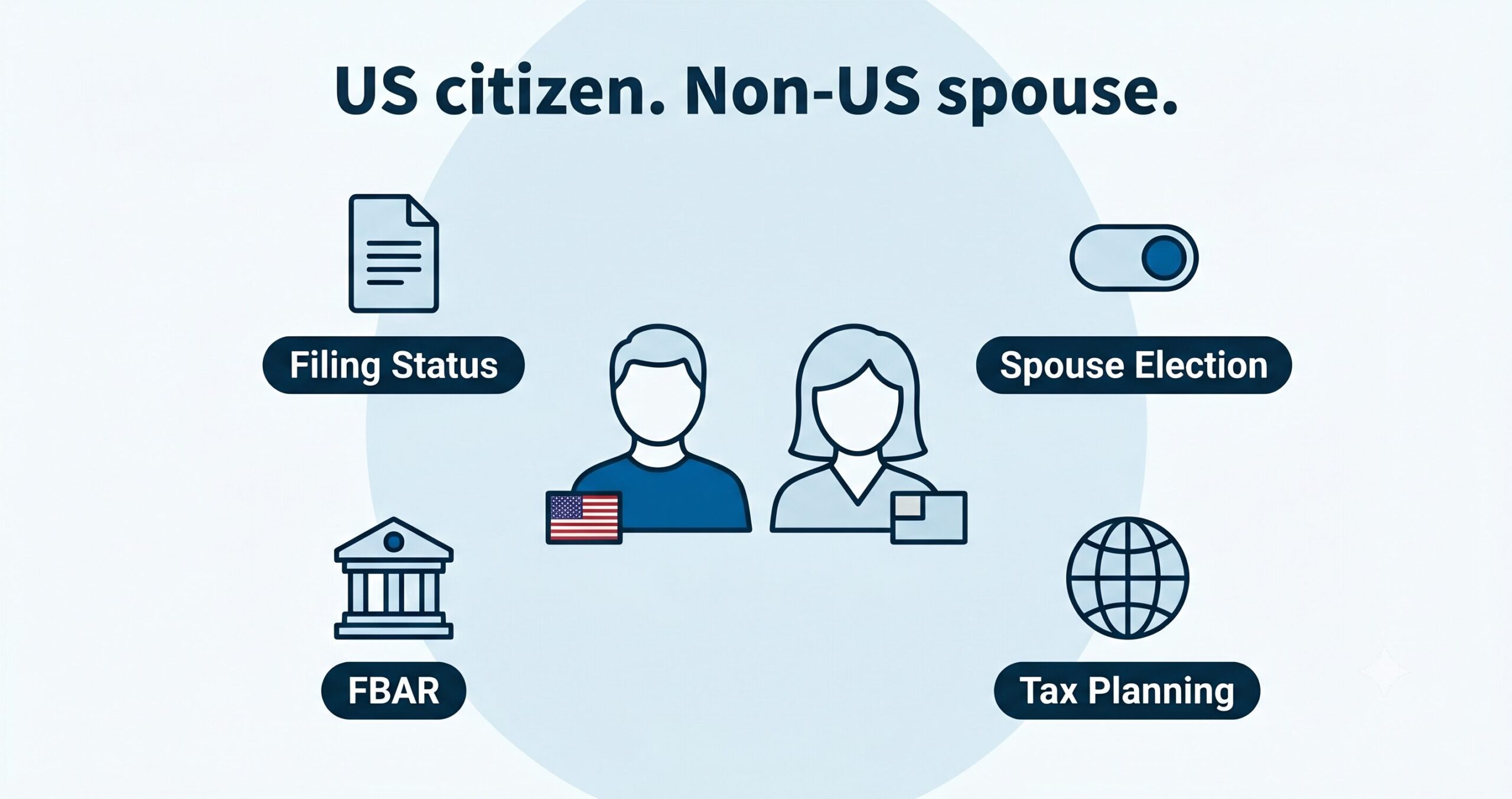
This guide covers the four decisions every mixed-citizenship couple needs to understand: how to file, whether to make the non-resident spouse election, how your spouse’s foreign accounts affect your FBAR obligations, and how to approach income and asset planning across two different tax systems.
The first question every mixed-citizenship couple faces is whether to file jointly or separately on the US tax return. The answer is not obvious and depends heavily on your specific income composition.
Filing jointly includes your non-US spouse’s worldwide income on your US return. For a couple where the non-US spouse earns significant income, this can substantially increase the US tax liability. However, filing jointly also unlocks access to more favorable tax brackets, higher standard deductions, and certain credits that are not available to married filing separately filers. In some situations, particularly where the non-US spouse earns little or no income, joint filing produces a lower overall tax bill.
Filing separately keeps your non-US spouse’s income off your US return entirely, which is often the right choice when your spouse earns significant income in a high-tax country or has complex foreign financial interests you do not want reported to the IRS. The trade-off is losing access to certain deductions and credits available only to joint filers.
There is no universal right answer. The decision requires running the numbers both ways, accounting for the Foreign Tax Credit on any foreign income included in a joint return, and considering the long-term implications of whichever election you make. What matters is that the decision is made deliberately, not by default.
If your non-US spouse is not a US citizen or green card holder and does not meet the substantial presence test, they are classified by the IRS as a non-resident alien. By default, a non-resident alien spouse is not included on a US tax return at all.
However, there is an election available under IRC Section 6013(g) that allows you to treat your non-resident alien spouse as a US resident for tax purposes. This means including their worldwide income on a joint US return, but it also means accessing joint filing benefits and, in some cases, producing a lower overall tax bill.
Why would anyone choose this? The election makes sense in specific circumstances. If your non-US spouse earns little or no income, electing to treat them as a resident allows you to file jointly and access the joint filing tax brackets and standard deduction without significantly increasing your taxable income. It can also be beneficial if you have children and want to claim certain family-related credits that require joint filing.
Why would you not choose it? If your spouse earns substantial income in a country with a tax treaty or in a high-tax environment, bringing that income onto a US return can create tax liability that outweighs the joint filing benefits. It also subjects your non-US spouse’s global income to US reporting permanently until the election is formally revoked.
The election is made by attaching a statement to your jointly filed return and is generally irrevocable for the year it is made. Reversing it in subsequent years requires meeting specific conditions. This is a decision worth making with professional guidance, not on instinct.
This is the area that surprises mixed-citizenship couples most consistently.
As a US citizen, you are required to file an FBAR if you have a financial interest in or signature authority over foreign financial accounts with an aggregate value exceeding $10,000 at any point during the year. Most people know this applies to their own accounts. Fewer people know how it interacts with jointly held accounts and a non-US spouse’s separate accounts.
Jointly held accounts between you and your non-US spouse count toward your FBAR threshold and must be reported on your FBAR. The full value of a jointly held account is reportable, not just your half.
Your spouse’s separate accounts generally do not trigger your FBAR obligation unless you have a financial interest in them or signature authority over them. Having a non-US spouse does not automatically make their accounts your reporting obligation.
However, the lines can blur. If you are a co-signer on an account, have power of attorney, or can direct transactions on an account your spouse holds, that can create a signature authority obligation. If your spouse’s accounts are held through a joint entity you both own, that may trigger a financial interest. These situations require a careful review of what you actually control, not just what is in your name.
There is also Form 8938, filed with your US tax return and separate from FBAR, which requires reporting specified foreign financial assets above higher thresholds. Some couples are required to file both. Filing one does not satisfy the obligation to file the other.
The most overlooked dimension of mixed-citizenship taxation is proactive planning. Most couples focus on compliance: filing correctly, reporting what needs to be reported. Fewer think about how to structure their finances to minimize their combined tax burden across both systems.
A few areas worth understanding:
Income splitting is possible in some situations. If one spouse is in a significantly lower tax bracket in their country, structuring certain income sources to flow through that spouse can reduce the overall household tax burden. This requires careful analysis of both countries’ attribution rules and any applicable tax treaties.
Tax treaty benefits are available between the US and most developed countries and can affect how specific types of income, pensions, and assets are taxed. Treaty provisions vary significantly by country and by income type. A pension earned in Germany is treated differently under the US-Germany treaty than a pension earned in France is treated under the US-France treaty. Country-specific treaty analysis is worth doing before making decisions about pension contributions, investment structures, or retirement planning.
Estate and gift planning is a separate but related area where mixed-citizenship marriages create complexity that pure domestic marriages do not. The unlimited marital deduction that applies to transfers between two US citizens does not apply in the same way when one spouse is a non-US citizen. Gifts to a non-US citizen spouse above an annual threshold are subject to gift tax. These implications are worth understanding before significant wealth transfer decisions are made.
Foreign pensions held by the non-US spouse are one of the most frequently overlooked reporting items for mixed-citizenship couples. Depending on the pension structure and the applicable tax treaty, a foreign pension may need to be reported on FBAR, Form 8938, or both, and the income from it may or may not be taxable in the US depending on treaty provisions.
After 15 years working with mixed-citizenship couples, the situations that create the most problems are not the result of deliberate choices to do something wrong. They are the result of each decision being made in isolation.
A filing status choice made without considering the FBAR implications. A spouse’s pension accumulated for years without anyone checking whether it creates a US reporting obligation. A jointly held account that crosses the $10,000 threshold on a single day and creates an FBAR requirement neither spouse knew existed.
The complexity here is real. But it is manageable when someone is looking at the full picture of both systems simultaneously.
Does my non-US spouse have to file a US tax return?
Not automatically. If your non-US spouse has no US-sourced income and you do not make the non-resident spouse election, they generally have no US filing obligation. If you make the election to treat them as a US resident for tax purposes, they are included on your joint return and their worldwide income is reported.
Do I have to report my spouse’s foreign bank accounts on my FBAR?
You are required to report accounts in which you have a financial interest or signature authority. A jointly held account must be reported. Your spouse’s separate accounts generally do not trigger your FBAR obligation unless you have control over them in some form.
What is the non-resident spouse election and should we make it?
The Section 6013(g) election allows you to treat your non-US citizen, non-green card holding spouse as a US resident for tax purposes and file jointly. It can produce a lower tax bill when your spouse has little or no income, but it subjects their worldwide income to US reporting and is not easily reversible. Whether it makes sense depends entirely on your specific income composition.
Can a non-US citizen spouse get a US tax ID number?
Yes. A non-US citizen who is not eligible for a Social Security number can apply for an Individual Taxpayer Identification Number (ITIN) through Form W-7. An ITIN is required to file a joint US return if your spouse does not have a Social Security number.
How do tax treaties affect a mixed-citizenship couple?
Tax treaties between the US and your spouse’s home country can affect how specific income types, pensions, and assets are taxed. Treaty provisions are highly specific to each country and each income type. The US-UK treaty treats certain UK pension income differently from how the US-Germany treaty treats German pension income, for example. Treaty analysis is worth doing as part of any comprehensive tax planning review for a mixed-citizenship couple.
Does having a non-US spouse affect my FEIE or Foreign Tax Credit eligibility?
No directly. Your eligibility for the FEIE and Foreign Tax Credit is based on your own residency, income, and foreign tax payments. However, the filing status decision (joint vs. separate) affects how these tools can be applied, and in some cases a joint return can create opportunities or complications for the FTC that a separate return would not.
Mixed-citizenship tax situations are among the most nuanced we handle. If you have questions about your specific situation, a consultation is the right starting point. Book a consultation and we will look at the full picture together.
Filing US taxes as an American abroad is complex. We help make it easy for you.