Ready to seek assistance with your US taxes?
Filing US taxes as an American abroad is complex. We help make it easy for you.


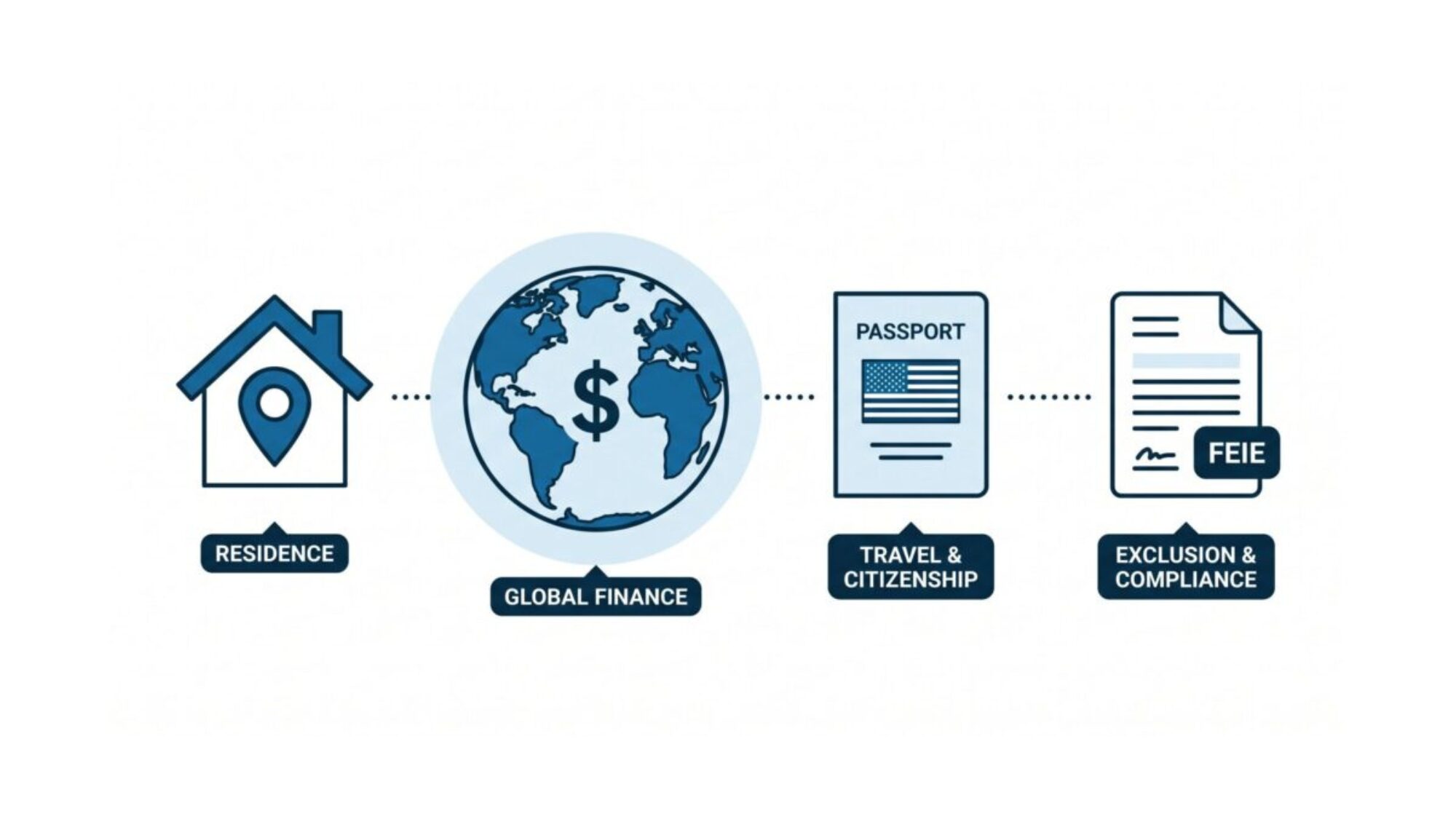

More Americans are leaving the United States right now than at any point in modern history. The State Department processes record numbers of expat-related filings every year, and the trend is accelerating.
I’m not going to tell you whether you should leave. What I can tell you is what my clients actually say when they do. Over fifteen years of running an international tax firm, working with Americans in over 93 countries, I’ve heard the same reasons come up again and again. Here they are, in the order we actually hear them.
This is the most common reason, and the math is striking once you see it clearly. A two-bedroom apartment in a great Lisbon neighborhood runs roughly $1,500 to $2,000 a month. The equivalent in San Francisco is around $6,000. Mexico City, Medellín, and Bangkok tell a similar story.
When you earn in one of the world’s strongest currencies and spend somewhere else, you are not just reducing expenses. You are compressing the gap between your income and your lifestyle in a way that simply does not happen if you stay put. For people with remote income or dollar-denominated businesses, this is often the most immediate financial argument for making a move.
Five years ago, telling your employer you wanted to work from another country was often a career risk. Today, a significant portion of our clients work for US companies that do not ask, do not object, or actively support location flexibility. The infrastructure is there. Deliverables get delivered. The video calls work.
This does not apply universally. Some employers push back, and some roles require physical presence. If your employer is hesitant, there are paths worth exploring, including local payroll arrangements or a transition to independent contractor status, depending on the specifics of your situation. But for a large and growing segment of American professionals, the practical barrier that used to exist simply does not anymore.
The assumption is that healthcare abroad means lower quality. What our clients consistently report is lower cost for comparable or better care in most major expat cities.
To put it in concrete terms: ear surgery with skin grafting in Brazil recently cost roughly $4,000. The equivalent procedure in the US would have run closer to $20,000. A standard dental checkup in Sao Paulo runs around $30. These are not outliers. They are representative of what Americans encounter in places like Lisbon, Bangkok, Medellín, or Buenos Aires, cities with hospitals and practitioners that meet international standards.
The healthcare cost difference is one of the reasons many clients tell us they finally feel financially stable abroad in a way they did not at home.
This one belongs on any honest list of financial reasons to move abroad. The Foreign Earned Income Exclusion, filed on Form 2555, allows qualifying Americans abroad to exclude roughly $130,000 of earned income from US federal income tax each year. For a married couple where both spouses qualify, that number doubles to approximately $260,000.
To qualify, you generally need to be physically outside the US for at least 330 days in a 12-month period, or have genuinely established your life as a resident of another country. This is not a loophole or a gray area. It is written directly into the tax code and has been available to American expats for decades.
This is worth being concrete about. When I left Wall Street and moved to Buenos Aires, the combination of lower expenses and the FEIE is what made it financially viable to build Online Taxman from a one-person operation into a firm of over 60 people. The savings did not stay in my pocket; they went into hiring, marketing, and growing the business. The math of living abroad does not just change your lifestyle. For many people it changes what becomes possible professionally.
Dollar-denominated savings buy very different things in different markets. A modern two-bedroom apartment in central Lisbon runs around $600,000. A house with a pool in Medellín can be found for $300,000. A penthouse in Bangkok with city views is often available under $1,000,000.
For people who could not realistically own property in San Francisco, Austin, Miami, or New York, these numbers represent access to a kind of ownership that was simply not available to them at home. Many clients who made the move are now homeowners in cities they actively want to live in, which is a different life outcome than renting in a city where they were priced out of ownership entirely.
The conventional assumption is that the US is safe and most other places are not. The experience of Americans living in cities like Lisbon, Singapore, Vienna, Tokyo, or parts of Bangkok and Mexico City is frequently the opposite.
Petty crime exists everywhere. But the kind of ambient anxiety that many Americans carry in major US cities, the background awareness of personal safety that most people have normalized, is genuinely lower in a lot of expat hubs. Clients who expected to feel less safe abroad often report feeling more so. This is not a universal statement about every country or city. It is an observation about the specific places most Americans who relocate intentionally choose to go.
Federal tax is only part of the picture. Americans in California, New York, New Jersey, and other high-tax states are paying state income tax on top of federal. California’s top marginal rate exceeds 13%. New York City residents pay city tax on top of state tax.
When you move abroad and properly establish non-residency in your former state, that bill can go to zero. We have had clients reduce their annual tax burden by $20,000, $30,000, or more simply from the state side alone, before factoring in the FEIE or any other international planning.
The key word is “properly.” States like California are aggressive about claiming continued residency if ties are not clearly severed. That means transferring your driver’s license, updating your voter registration, removing your name from any lease or property in the state, and making sure your mail, financial accounts, and professional registrations reflect your new address. It is a process, but when done correctly the savings are immediate and ongoing.
Financial reasons tend to get people interested in moving abroad. Quality of life is usually what makes them actually go, and what makes them stay.
Walkable cities. Functioning public transit. Neighborhoods where people spend time outdoors, know their neighbors, and eat meals that were not processed. A pace that is not built around maximizing productivity at all times.
When I moved to Argentina, I noticed something I had not expected. Despite economic instability and inflation that made long-term saving difficult, people there spent their money on what mattered to them immediately: meals with friends and family, weekend trips, time together. Because money lost value quickly, they did not defer life. That observation stayed with me and shaped a lot of how I think about what “doing well” actually means.
More and more of our clients are making this move not because they calculated a tax savings, but because they looked at how they were living and decided it was not what they wanted. The financial case makes it possible. The quality of life case makes it feel right.
Italy, Ireland, Poland, Spain, and Portugal all have programs that allow people to claim citizenship through ancestry, sometimes going back to grandparents or great-grandparents. If you have the right family history, you may already qualify for an EU passport without ever having lived in the country.
That changes the calculus of moving significantly. Rather than navigating visa renewals or residency permits on an annual basis, an EU passport provides full residency and work rights across the entire European Union, plus access to European healthcare systems and a travel document that opens considerably more doors than a US passport alone.
A number of our clients came to us with a vague interest in moving abroad, discovered they were one paperwork process away from Italian or Irish citizenship, and found that their timeline accelerated considerably once that option became concrete.
This is the reason that determines how much of everything else on this list you actually capture.
Beyond the FEIE, a number of countries have specific programs designed to attract foreign residents, each with different structures and eligibility requirements. Portugal has offered favorable tax treatment for qualifying new arrivals. Italy has a flat tax option for high earners relocating there. Greece, Spain, and the UAE have comparable programs. Turkey’s recently announced proposal, if it passes into law, would offer one of the most extended runways available at 20 years for qualifying new residents.
These are not gray areas or loopholes. They are official programs each country uses to attract residents with outside income or capital. When combined with proper US tax planning, the total picture can look dramatically different from what you are currently paying.
The catch, and it is an important one, is that this only works when planned before the move. The structure you establish, the timing of your departure, how your business income is characterized, and which forms get filed in what order all matter. Done correctly, this is one of the highest-leverage financial decisions a successful American can make. Done in the wrong order, it creates problems that take years to unwind.
The ten reasons above are the real ones. Not the romanticized version, not the social media version. The actual reasons people make this decision when they sit across from us and explain it.
The most common mistake we see is doing the move first and thinking about the tax and legal structure second. The structure has to come first, because how you set up the move determines how much of the financial benefit you actually keep.
If any of these reasons resonated, the best next step is a conversation about your specific situation before you book a flight.
Filing US taxes as an American abroad is complex. We help make it easy for you.